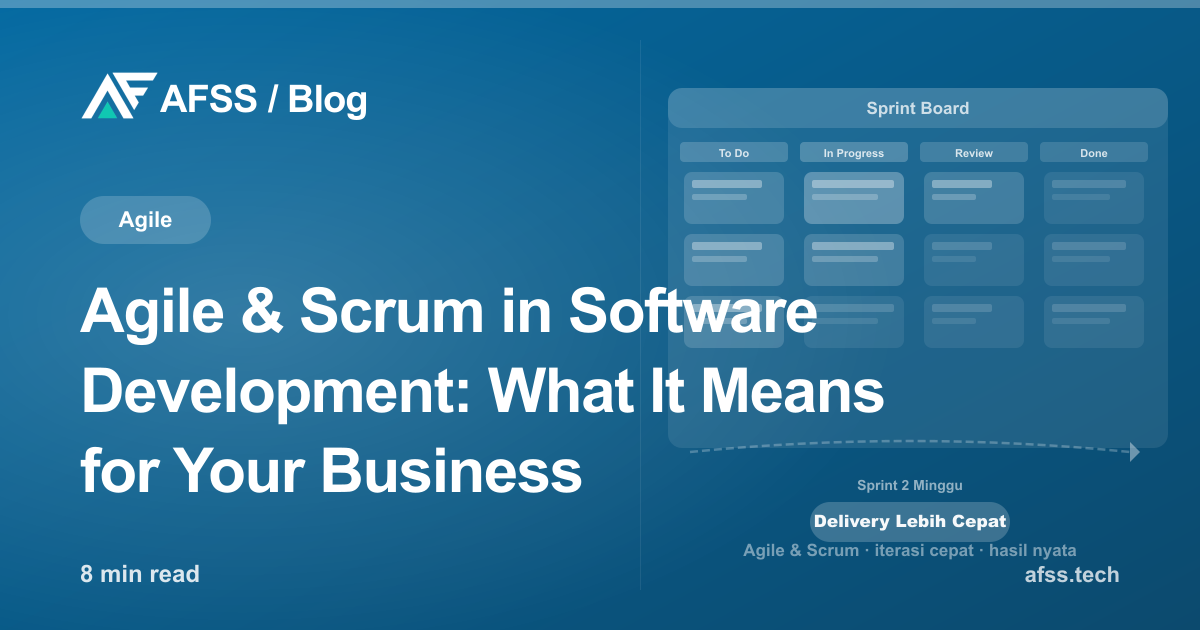
You've probably heard the words "Agile" and "Scrum" often from your technical team or software house vendor. But what do these terms actually mean, and why does it matter for you as a business owner or product owner to understand them?
The answer is simple: the development methodology a technical team uses directly affects the speed, cost, and quality of the software you get. Understanding Agile doesn't mean you have to start coding — it's about understanding how a team works so you can collaborate more effectively, make decisions faster, and avoid the all-too-common scenario of "the website is finished but not what we wanted."
What Is Agile?
Agile is a software development approach that prioritizes flexibility, collaboration, and delivering value incrementally. Unlike the traditional approach (called Waterfall), where all features are designed upfront and only delivered after everything is complete, Agile works in short cycles that produce something usable at every iteration.
Agile's core principles (from the Agile Manifesto, 2001):
- Individuals and interactions over processes and tools
- Working software over comprehensive documentation
- Customer collaboration over contract negotiation
- Responding to change over following a plan
This doesn't mean documentation or planning aren't important — rather, when forced to choose between sticking to the original plan or responding to real changing needs, Agile chooses the latter.
What Is Scrum?
Scrum is the most popular framework for implementing Agile in software development. Scrum defines a concrete working structure: roles, events (rituals), and artifacts.
Roles in Scrum
Product Owner (PO) — The person representing business and user interests. Responsible for defining and prioritizing which features need to be built. In the context of working with a software house, this is often you or a representative from the client's side.
Scrum Master — A facilitator who ensures the team follows the Scrum process correctly and removes obstacles blocking the team. Not a manager, but an enabler.
Development Team — The team actively building the software: developers, designers, testers. Self-organizing and cross-functional.
Sprint: The Smallest Unit of Work
Work in Scrum is divided into Sprints — work periods typically 1–4 weeks long (commonly 2 weeks). At the start of each Sprint, the team selects work items from the backlog (a prioritized list of features) to complete during that Sprint. At the end of the Sprint, the result is software that can genuinely be demonstrated — not just a plan or mockup.
Sprint Planning
At the start of each Sprint, the team and Product Owner meet to discuss and select which features will be worked on. This is a critical moment where business priorities meet the team's technical capacity.
Daily Standup (Daily Scrum)
A short daily meeting (15 minutes) where each team member answers three questions: what they did yesterday, what they'll do today, and what obstacles they're facing. This isn't a status meeting — it's a team synchronization mechanism.
Sprint Review
At the end of the Sprint, the team demonstrates what was successfully built to stakeholders. This is an opportunity to get real feedback from users or clients before moving on to the next Sprint.
Sprint Retrospective
After the Sprint Review, the team conducts an internal evaluation: what went well, what can be improved, and what will change in the next Sprint. This is the continuous improvement mechanism that makes the team increasingly effective over time.
Why Is Agile Better Than Waterfall for Most Projects?
The Problem with Waterfall
In the traditional Waterfall approach, the entire software specification is defined upfront before coding begins. After the contract is signed, specification documentation is written (which can take weeks), and only then does development start. Results can only be seen after development is fully complete.
The problem: requirements change. What looked like a clear requirement at the start often changes after seeing a prototype. Markets shift. Competitors launch new features. Users provide feedback that couldn't have been predicted from initial discussions.
With Waterfall, mid-project changes are very expensive because they mean redoing a lot of work already done.
Advantages of Agile
Early feedback. You see and use the software within the first 2 weeks, not 6 months later. If the direction is off, it can be corrected immediately before too much investment is wasted.
Flexibility. Priorities can change between Sprints. If a more important feature suddenly emerges, it can be prioritized in the next Sprint without having to change the entire project plan.
Better risk management. With deliverables every 2 weeks, risk is concentrated within each Sprint — not piling up until the end of the project.
Higher transparency. You always know what's being worked on, what's finished, and what's blocking progress.
A product that better fits actual needs. With a continuous feedback loop, the final product is usually much closer to what users actually need compared to a product built purely from initial specifications.
Your Role as Product Owner
If you're working with a software house that uses Agile, your role as client (or Product Owner) is critical. Here's what you need to understand:
Actively Manage the Product Backlog
The Product Backlog is a list of all the features, fixes, and work that need to be done. You're responsible for making sure the backlog is always updated and prioritized according to business value. The most important features should be at the top of the backlog so the team works on the highest-impact items first.
Write Good User Stories
Features in Agile are usually written as User Stories — a brief description from the user's perspective: "As a [type of user], I want to [do something] so that [I get a benefit]."
Example: "As a customer, I want to be able to save products to a wishlist so I can buy them later without having to search for them again."
A good User Story helps the team understand context and purpose, not just technical specifications.
Be Responsive to the Team
In Scrum, the team needs decisions and feedback quickly. If the Product Owner isn't responsive, the Sprint can stall because the team can't proceed without clarity. Your availability directly affects development speed.
Attend the Sprint Review
The Sprint Review is a moment where you can see progress firsthand and provide feedback. Active participation here is an extremely efficient investment of time — one hour every two weeks can prevent weeks of misdirected work.
Agile Doesn't Mean No Documentation
One common misconception: Agile means no documentation is needed. This is wrong. Agile means documentation should be proportional and useful — not a 200-page specification document that's never read again after being signed.
Documentation that remains important in Agile:
- Architecture decision records (important technical decisions and the reasoning behind them)
- API documentation (if the software integrates with other systems)
- User guides for complex features
- Deployment and maintenance procedures
Estimation in Agile: Story Points
Agile teams often use Story Points for estimation — not hours or days. Story Points measure relative complexity and effort, not absolute time. Each Sprint, the team has a velocity (average story points completed) based on previous Sprints' experience.
This might feel counterintuitive for business owners used to estimates in "how many days will this take." The explanation: estimates in hours are very inaccurate because they don't account for complexity, interruptions, and other variables. Story Points are more honest about uncertainty.
Tools Used by Agile Teams
Some common tools your team might use:
- Jira — the most popular backlog and Sprint management tool
- Trello / Notion / Linear — lighter alternatives for smaller teams
- GitHub / GitLab — for code management and code review
- Figma — for design and prototyping
- Slack / Teams — day-to-day team communication
As a client, you may be invited to view or contribute to a Jira/Trello board so you can track progress transparently.
When Isn't Agile a Good Fit?
Agile works best for projects where requirements aren't fully clear upfront or are likely to change. There are situations where a more structured approach fits better:
- Projects with very strict, unchangeable specifications (e.g., integration with a regulatory system)
- Teams highly distributed across time zones with difficult communication
- Very small projects that don't need Scrum process overhead
For most website, mobile app, and business system development projects, Agile is the best choice.
Conclusion
Understanding Agile and Scrum doesn't mean you have to become a developer. It's about understanding the best way to collaborate with a technical team to produce a digital product that genuinely meets your business needs — faster, more cost-effectively, and with better-controlled risk.
At AFSS, we use an Agile approach for every software development project. We believe that transparency, active communication, and rapid iteration are the keys to producing digital products that truly succeed. Learn more about our working process.
Have a similar project?
Free consultation, no commitment. Tell us what you need — we'll help you find the best solution.
Free Consultation