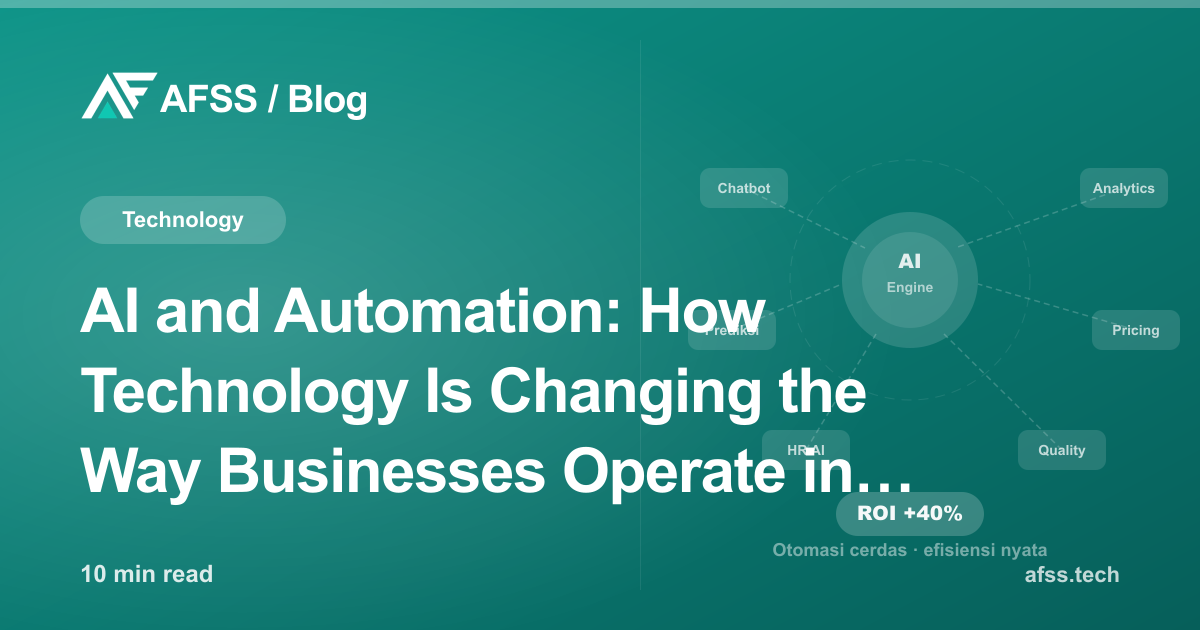
AI and Automation: How Technology Is Changing the Way Businesses Operate in 2026
Two years ago, many business owners in Indonesia still saw AI (Artificial Intelligence) as a distant, futuristic technology. In 2026, that view is no longer relevant. AI is already at work in thousands of Indonesian businesses — as customer service chatbots, product recommendation systems, automated report analysis, and real-time fraud detection.
What's changed isn't just the technology — it's the accessibility. AI solutions once reserved for Fortune 500 companies are now available to businesses with budgets of Rp 5M–50M per month.
AI in Business: What's Already Happened?
Before discussing what you can do, it's important to understand what has already happened across the Indonesian and global business ecosystem.
24/7 Automated Customer Service
New-generation AI-powered chatbots (not the old rule-based chatbots) can already handle 60–80% of customer inquiries without human intervention. They understand context, handle language variations, and know when to escalate to a human agent.
Indonesian retail, fintech, and e-commerce businesses have adopted this at scale. The result: customer service operating costs down 40–60%, response times shrinking from hours to seconds, and higher customer satisfaction thanks to 24/7 availability.
Predictive Data Analysis
AI can analyze historical sales data and deliver accurate demand predictions — helping businesses manage inventory more efficiently. For distribution and retail businesses, this means up to a 30% reduction in excess stock and up to a 45% reduction in stockouts.
In finance, AI helps predict cash flow, detect transaction anomalies (potential fraud), and analyze profitability by product or customer segment.
Mass Personalization
Netflix, Tokopedia, Shopee — they all use AI to surface content and products relevant to each individual. By 2026, this technology is accessible to mid-sized businesses through affordable APIs.
Real results: e-commerce businesses that implement AI recommendations see an average order value increase of 15–35% and a 20–30% drop in bounce rate.
7 Areas Where AI Delivers the Fastest ROI
1. Email & Marketing Communication Automation
AI can write, schedule, and optimize marketing emails based on recipient behavior. Emails sent at the right time, with optimized subject lines and content relevant to each segment.
Estimated ROI: Open rates up 25–40%, revenue per email up 20–30%.
2. Financial Report Analysis
Instead of a CFO or accountant spending 10 hours building a monthly report, AI can draft the report, flag anomalies, and highlight KPIs that need attention — in a matter of minutes.
Estimated ROI: 60–80% reduction in reporting time.
3. Lead Scoring & Sales Prioritization
AI analyzes prospect data (industry, company size, website behavior, interaction history) and scores each lead by likelihood to close. The sales team focuses on the highest-scoring leads — not just the newest ones.
Estimated ROI: Win rate up 20–35%, sales cycle shortened by 15–25%.
4. Visual Quality Control (Manufacturing)
Computer-vision-based AI can inspect thousands of product units per minute — catching defects that tired human eyes often miss. These systems are now affordable and can integrate with standard cameras.
Estimated ROI: Defect rate down 40–70%, rework costs significantly reduced.
5. Recruitment & Candidate Screening
AI helps screen hundreds of CVs against criteria set by HR, detects bias, and automatically schedules interviews. Time-to-hire drops dramatically.
Estimated ROI: Time-to-hire down 40–50%, better quality of candidates reaching the interview stage.
6. Customer Churn Prediction
AI identifies customers at risk of canceling their subscription or not placing repeat orders — well before they leave. Businesses can intervene proactively (retention discounts, personal outreach) before it's too late.
Estimated ROI: Churn rate down 15–30%, customer lifetime value up.
7. Dynamic Pricing
AI adjusts prices in real time based on demand, stock, competitor pricing, and timing. Airlines and hotels have done this for decades. By 2026, Indonesian retail and B2B services are starting to adopt it too.
Estimated ROI: Revenue per unit up 8–20% without significant volume loss.
Challenges of AI Adoption for Indonesian Businesses
Honestly — AI adoption isn't as smooth as vendors make it sound. There are real obstacles:
Data That Isn't Ready Yet
AI learns from data. If your business data is scattered across spreadsheets, WhatsApp chats, and inconsistent manual notes, AI can't perform optimally. Investing in data hygiene is a prerequisite for successful AI adoption.
Employee Resistance
"AI will take my job" is a real fear. And partly, it's true — AI does automate some routine work. Management needs honest communication and reskilling programs for affected employees.
Lack of In-House AI Talent
Implementing and maintaining AI systems requires skills that are still scarce in Indonesia. The solution: partner with an experienced technology provider, or adopt AI-as-a-service solutions that don't require an internal ML team.
Miscalculated Implementation Costs
AI isn't a buy-install-done kind of software. There are integration costs, data preparation, model training, and ongoing optimization that often get left out of initial ROI calculations.
How to Get Started: An AI Roadmap for Mid-Sized Businesses
Phase 1: Audit & Data Preparation (1–3 months)
- Identify the business processes most in need of efficiency
- Audit the quality and completeness of available data
- Standardize data collection for the problem you're trying to solve
Phase 2: Quick Wins with AI-as-a-Service (3–6 months)
Start with existing (API-based) solutions before building from scratch:
- Chatbots: Dialogflow, IBM Watson, or local solutions
- Email AI: Klaviyo, Mailchimp with AI features
- Analytics: Google Analytics 4 (already has a lot of AI built in), Mixpanel
- Customer sentiment: social media monitoring tools with AI analysis
Phase 3: Customization & Integration (6–12 months)
Once you've proven ROI from quick wins, invest in:
- Integrating AI into your existing ERP/CRM systems
- Custom models for your specific business use cases
- Integrated analytics dashboards
Phase 4: AI as a Core Competency
At this point, AI has become part of your business's operational DNA — not just a tool. Business decisions are based on AI insights, and teams are already used to collaborating with automated systems.
AI Isn't a Replacement for Humans — It's an Amplifier
The wrong framing of AI is "AI replaces humans." A more accurate framing: AI amplifies human capability.
A salesperson assisted by AI lead scoring can manage a 3x larger pipeline. A financial analyst assisted by AI can produce deeper reports in less time. A customer service agent assisted by an AI chatbot can focus on complex cases that truly require human empathy.
The most successful businesses in 2026 aren't the ones using the most AI — they're the ones that best combine AI with the human strengths machines can't replace: creativity, empathy, ethical judgment, and a deep understanding of business context.
Concrete Next Steps for Your Business
Don't rush to implement everything at once. Pick one business problem that hurts the most and find an AI solution specific to that problem.
Example approaches we recommend:
- Retail/e-commerce businesses — start with a customer service chatbot and product recommendation system
- Distribution/manufacturing businesses — start with demand forecasting and inventory optimization
- Professional services — start with lead scoring and follow-up automation
- F&B — start with demand prediction for menu planning and waste reduction
AFSS has an experienced team integrating AI solutions into Indonesian business systems — from natural, Indonesian-language customer service chatbots to predictive analytics dashboards connected to your operational data.
Discuss your business's AI needs with us — we start by understanding the problem, not selling technology.
Have a similar project?
Free consultation, no commitment. Tell us what you need — we'll help you find the best solution.
Free Consultation