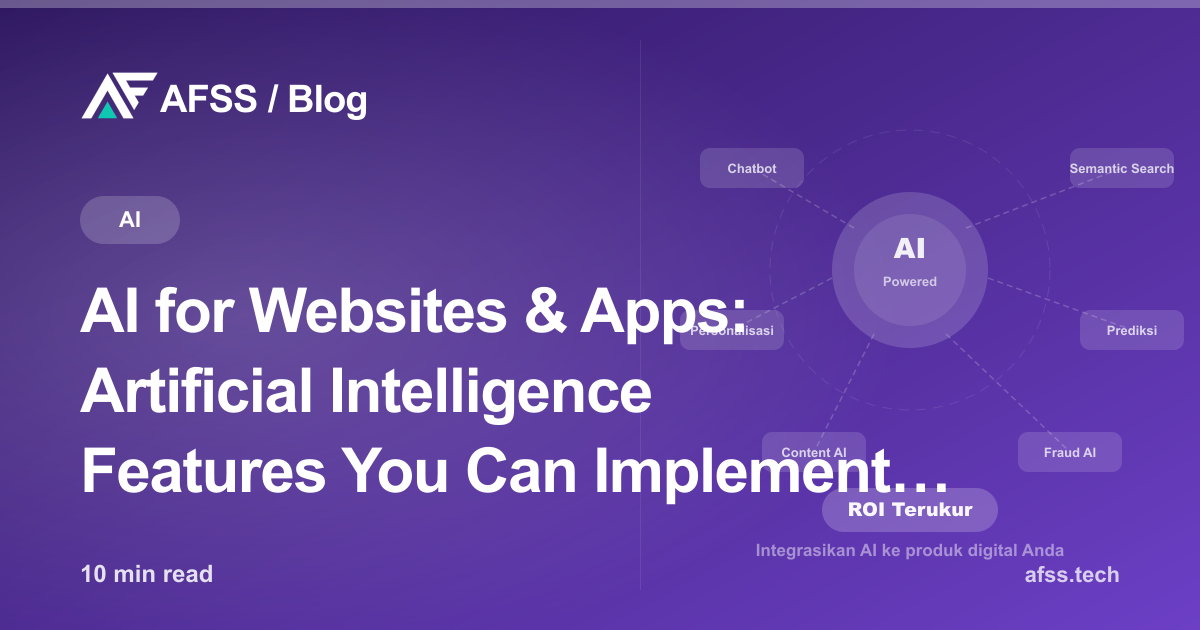
In 2026, artificial intelligence (AI) is no longer the exclusive domain of big tech companies. APIs like Claude, GPT-4, and Gemini let anyone integrate AI capabilities into a website or app within days — not months. The question is no longer "do we need AI?" but "which AI feature will have the most impact on my business?"
This article covers AI features that are mature, proven to work, and ready for you to implement directly into your digital product.

Why Is AI Relevant for Businesses of Any Size?
In the past, building an AI feature required a team of data scientists, thousands of GPUs, and datasets with millions of rows. Now, foundation AI models are available via API and can be called with a few lines of code. The entry cost has dropped drastically — from hundreds of millions of rupiah to hundreds of thousands of rupiah per month.
What's changed isn't just the cost — it's also the quality. 2026-era AI models can understand context, language nuance, and even ambiguous instructions with an accuracy that wasn't possible before.
1. Chatbots & AI Customer Support
This is the most common AI application and often delivers the highest ROI.
What it can do:
- Automatically answer FAQ questions, 24/7
- Qualify leads (separate serious prospects from casual browsers)
- Help customers find the right product or service
- Collect information before handing off to a human team
- Provide order status, tracking, or account information
How it works:
Modern chatbots are no longer based on rigid decision trees. They use Large Language Models (LLMs) that can understand questions in natural language, reference your business's knowledge base (products, policies, FAQs), and provide answers that are relevant and sound human.
The RAG (Retrieval-Augmented Generation) technique lets a chatbot answer based on your business's specific documents — not just the model's general knowledge.
Expected ROI:
- 40-60% reduction in level-1 support ticket volume
- 24/7 availability without additional headcount cost
- Response time from hours → seconds
Relevant tools:
For a custom implementation, you'll need: an LLM API (Claude, OpenAI), a vector database (Pinecone, Supabase pgvector), and an orchestration framework (LangChain, LlamaIndex). For a faster solution, platforms like Intercom or Zendesk already have AI built in.
2. Semantic Search
Conventional search looks for exact matching words. A user types "running sports shoes" → the system searches for entries containing those exact words.
Semantic search understands meaning. A user types "footwear for morning jogging" → the system understands this means running shoes and shows relevant results — even though not a single word matches exactly.
When this is highly beneficial:
- E-commerce: Dramatically improves product discovery
- Documentation or knowledge base websites: Users find answers faster
- Content platforms: Blogs, articles, or videos found based on intent, not just keywords
- Internal search for ERP/CRM: Employees find data in a more natural way
Implementation:
Use text embeddings (converting text into numerical vectors that represent its meaning), store them in a vector database, then perform a similarity search on each query. Free embedding models from OpenAI, Cohere, or HuggingFace are already very good.
Improved search relevance can boost e-commerce conversion by 20-30%, according to various industry studies.
3. Content Personalization & Recommendations
Netflix recommends movies. Spotify recommends songs. Tokopedia recommends products. All powered by AI that learns user behavior.
This technology is now available to small and mid-sized businesses too.
Business applications:
- E-commerce: "Products you might like," "Frequently bought together"
- Blog/media: Personalized related articles for each user
- SaaS/dashboard: Displaying the features or data most relevant to each user
- Email marketing: Different email content per segment based on behavior
How it works, simply:
The system logs which products were viewed, time spent, what was purchased, what was skipped. A collaborative filtering or content-based filtering model then identifies patterns and provides personalized recommendations.
The result: Amazon's studies show that 35% of their revenue comes from their recommendation system. For smaller businesses, a 10-20% increase in average order value is very realistic.
4. Predictive Analytics
Instead of only looking at what has already happened, AI can predict what will happen.
Business applications:
- Churn prediction: Identify customers likely to cancel their subscription before they leave — and take proactive action
- Demand forecasting: Predict next month's needed inventory based on seasonal and historical trends
- Lead scoring: Determine which prospects are most likely to convert — prioritize your sales team's time
- Predictive maintenance: Identify when a machine or system will need servicing before it breaks down
How to get started:
You don't need to build a model from scratch. Platforms like Google Vertex AI, Azure Machine Learning, or AutoML tools let you train a prediction model with your own data without deep data science expertise.
For simple cases like lead scoring or churn prediction, even a spreadsheet with a linear regression formula can already provide useful predictions.
5. Automated Content Creation & Optimization
Generative AI can help your team create content faster and more consistently.
Proven applications:
- Automated A/B testing: AI generates headline, product description, or CTA variations, then determines which performs best
- Meta descriptions & SEO tags: Automatically create optimized meta descriptions for every product page — useful for e-commerce with thousands of products
- Translation & localization: Content automatically translated and adapted for different markets
- Summarization: Long articles condensed into key points for newsletters or social media
Important note:
Generative AI is an assistant, not a replacement for quality content. Content that's entirely AI-generated and not reviewed by a human often feels generic and inauthentic. Use AI for initial drafts or variations, then have a human polish and validate it.
6. AI-Based Anomaly Detection & Security
AI is very good at finding abnormal patterns — something difficult for rule-based systems to do.
Security applications:
- Fraud detection: Identify suspicious transactions based on patterns that deviate from normal
- Bot detection: Distinguish bot traffic from real users more accurately than conventional CAPTCHA
- Security monitoring: Real-time alerts when unusual login behavior or data access occurs
- Content moderation: Automatically detect policy-violating content on platforms with user-generated content
This is highly relevant for e-commerce, fintech, or platforms with large user bases.
7. Document Processing & Data Extraction
Businesses still relying on manual processes to handle documents — invoices, contracts, forms — can benefit greatly from AI.
Use cases:
- Invoice processing: AI reads and extracts data from invoices (vendor, amount, date) then automatically enters it into the accounting system
- KYC (Know Your Customer): Verify identity by automatically reading and validating an ID card or passport
- Contract analysis: AI highlights risky clauses or deviations from standard terms in a contract
- Form processing: Photographed or scanned forms are processed and their data extracted into a database
This eliminates repetitive manual work, reduces errors, and speeds up processes.
How to Start Integrating AI in Your Business
Step 1: Identify the use case with the highest ROI
Don't build AI just to "look sophisticated." First identify: which process is the most time-consuming, most error-prone, or would have the most impact on revenue if automated?
Step 2: Start with an API, not training your own model
For most businesses, using an existing model's API (Claude, GPT-4, Gemini) is far more cost-effective than training a model from scratch. Save resources for cases where your data is truly unique.
Step 3: A fast proof of concept
Build a prototype in 1-2 weeks. Test it with real data. Measure the right metrics (not just "does this feel useful?" but "what percentage of support tickets decreased?" or "how much did the conversion rate improve?").
Step 4: Iterate based on data
AI isn't perfect on the first attempt. Gather feedback, identify common failures, and improve iteratively.
Step 5: Monitor and maintain
AI models can "drift" over time — quality declines as the world changes but the model isn't updated. Monitor performance regularly.
Considerations Before Implementing AI
Privacy and Data
User data used for AI must be handled with great care. Make sure:
- Compliance with privacy regulations (GDPR, Indonesia's PDP Law)
- Sensitive data isn't sent to third-party APIs without encryption or anonymization
- Transparency with users about how their data is used
Accuracy and Bias
AI can be biased and wrong. Don't use AI for high-impact decisions (loans, hiring) without human review. Always keep a "human in the loop" for critical cases.
Cost
Large model APIs like GPT-4 or Claude charge per token. For high-volume applications, this cost can be significant. Estimate costs before building.
Conclusion
AI isn't a "magic bullet" that automatically solves every business problem. But for the right use cases — support automation, semantic search, recommendations, prediction — the impact can be very real and measurable.
Start with one use case that has the highest impact. Measure the results. Then expand.
AFSS helps businesses plan and implement pragmatic AI integration — from simple chatbots to more complex predictive analytics systems. Get a free consultation to discuss your business's AI roadmap.
Have a similar project?
Free consultation, no commitment. Tell us what you need — we'll help you find the best solution.
Free Consultation