Welding & Metal Fabrication Workshop Management Software
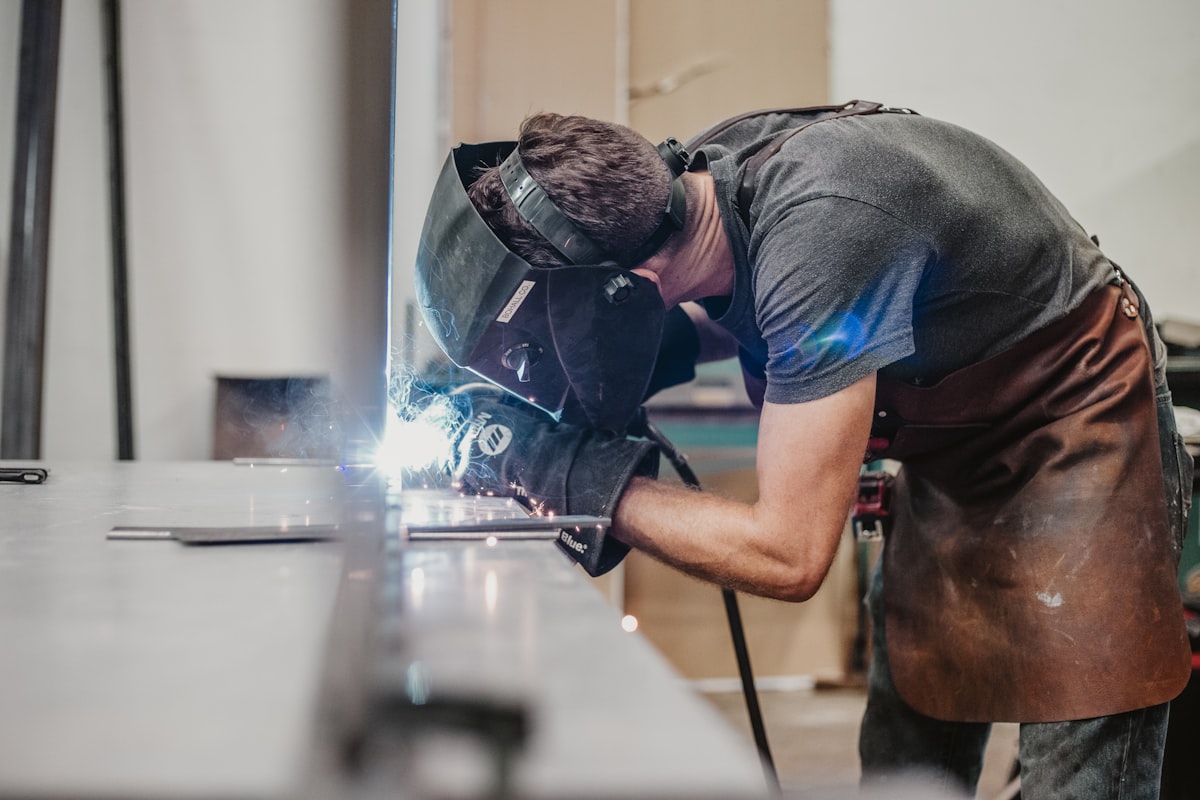
Mr. Slamet Riyadi has been running Cahaya Baja Welding Workshop in the Jababeka industrial estate in Cikarang for eight years. The jobs that come in vary widely: home security fences, carport canopies, steel water tanks, warehouse racking, and even production machine frames ordered by textile factories around Cikarang. Every day the shop admin writes new orders on a whiteboard by the entrance — client name, job type, target completion date — while design drawings and dimension specs stay scattered across WhatsApp folders and hand-scribbled sketches from the draftsman. Pricing estimates are calculated roughly by Mr. Slamet himself, based on years of experience: he guesses how much hollow steel, plate, welding rod, and paint a job will need, then adds labor cost multiplied by an estimated number of working days. There is no standard record of exactly how many bars of hollow steel a job actually consumed, how many kilograms of welding rod were used, or how many overtime hours the welders logged outside normal shift hours — because unlike a shop that sells the same stock items every day, every fabrication job is genuinely different in size and design.
The real trouble surfaced when the workshop took on an order to build a security fence and steel canopy for a 40-meter logistics warehouse in the Cibitung industrial area. Mr. Slamet estimated the material needs by feel and quoted Rp 38 million, projecting a margin of roughly Rp 6 million. During production, the client requested three rounds of canopy design revisions — changing the roof slope and adding two extra support columns — which drove up hollow steel consumption, and three welders had to work six extra days of overtime that nobody logged on paper anywhere. Offcuts and scrap from plate and hollow steel cutting were never weighed or costed either. It was only after the project was finished and material purchase receipts were tallied up one by one that Mr. Slamet realized total material and overtime labor costs had reached Rp 42.2 million — the workshop had actually lost about Rp 4.2 million on a job that, on paper, should have earned Rp 6 million. The loss only became visible after delivery, once the client's payment had already been received in full, leaving nothing left to correct.
What is welding and metal fabrication workshop management software
Welding and metal fabrication workshop management software is a digital system that records every fabrication project as a unique job order — complete with dimensions, design drawings, the material list required, estimated labor hours, and the quoted price — then tracks the actual material consumption and welder labor hours from day one through delivery. This is different from a hardware store's point-of-sale system or a vehicle repair shop app that manages standard stock items at fixed prices. In a fabrication workshop, almost no two jobs are identical: fence job A needs 40 bars of 4x4 hollow steel in a minimalist design, while fence job B next door needs 55 bars with ornamental detailing — so the system has to be built around the concept of "one job, one cost calculation," rather than around a uniform product catalog. With the manual paper-and-whiteboard approach, this crucial information gets scattered and easily lost once a project ends and the work sheet is thrown away or misplaced.
The real cost of running a fabrication workshop without a centralized system
- Quoted estimates drift far from actual costs. Prices are guessed from feel and experience, without historical usage data from similar past jobs, so the gap between the selling price and the real cost is only discovered after the project is done — sometimes as a loss.
- Leftover material and steel offcuts go uncontrolled. Without per-job usage tracking, scrap plate and hollow steel from cutting piles up in the yard with nobody knowing how much rupiah value is actually being wasted.
- Welder labor hours are never measured per project. The workshop has no way to know which projects are taking far longer than estimated, making it impossible to evaluate which jobs are actually unprofitable despite their apparent size.
- Client design revisions go undocumented. Spec changes made over the phone or via WhatsApp often never reach the welders on the floor, triggering production errors and rework that add cost with no paper trail to justify billing the client extra.
- The owner never knows which projects are actually profitable. Without a quoted-versus-actual cost comparison per project, decisions to raise prices or decline certain order types are made on guesswork instead of data.
Key features every welding workshop management app must have
- Custom job order tracking with unique specs per project — every order is recorded as its own entity complete with design drawings, dimensions, material type, and client-specific notes, rather than being lumped in with generic stock items.
- Steel and material stock usage logging per job — every bar of hollow steel, sheet of plate, welding wire, and rod that leaves the warehouse is tied directly to a specific job number, so remaining stock and actual material cost stay accurate.
- Welder labor hour tracking per project — welders log start and finish times for each job via phone or tablet on the shop floor, including overtime, so actual labor cost can be calculated precisely per project.
- Job costing that compares quoted versus actual cost — the system automatically calculates the gap between the initial quote and real material-plus-labor cost, giving an early warning when a job starts running over budget before it's finished.
- Automatic quotation and cost estimate (RAB) generator — from the material list and estimated labor hours, the system builds a tidy, consistent cost breakdown and quotation letter, no longer handwritten.
- Real-time production status from cutting to delivery — every job has clear stages: cutting, welding, finishing, quality control, and delivery, so the owner and client can track progress without endless phone calls.
- Client approval and revision history kept on record — every design change the client approves is logged with a date and approver, giving valid proof whenever extra costs arise from mid-project revisions.
Buy an off-the-shelf app or build a custom system
Generic project management or inventory apps can sometimes be used as a stopgap, but most are designed for stores with fixed product catalogs, not for workshops handling differently specified jobs every single day. As a result, workshop owners usually end up forcing their workflow to fit the generic app's structure — features like per-job material tracking or quoted-versus-actual comparisons are often missing entirely, or can only be approximated through extra spreadsheets that add to the admin workload instead of reducing it.
A custom system built specifically for a welding and fabrication workshop's workflow lets every stage — from job order intake, material allocation from the warehouse, welder labor hour logging, through to RAB and invoice generation — follow the process that's already running on the shop floor, rather than the other way around. For mid-to-large workshops with a high volume of custom orders and thin per-project margins, the investment in a custom system typically pays for itself within the first few months once the leaks in material cost and unlogged labor hours start closing up.
Cost ranges and timelines in Indonesia
For small-to-medium fabrication workshops needing job order tracking, per-job steel stock logging, and basic job costing, a custom system investment typically falls between Rp 70 million and Rp 180 million with a 3 to 5 month build time. For larger workshops with multiple branches or production floors, supplier integration for steel stock, multi-level approval workflows, and more complex job costing analytics dashboards, costs can reach Rp 200 million to Rp 480 million with a 5 to 8 month build time. Beyond the initial development cost, budget for annual maintenance of roughly 15% to 20% of the project value for feature updates, bug fixes, and system adjustments as the workshop grows or adds new service lines such as pressure vessel fabrication or light steel construction.
Case study: Mitra Logam Perkasa Welding Workshop
Mitra Logam Perkasa Welding Workshop in Sidoarjo, East Java, began using a custom fabrication workshop management app at the start of its eighth year of operation, after experiencing a project loss similar to Mr. Slamet's. Before implementation, the owner could only estimate project margins with about 55% accuracy against actual costs, and an average of 12% of steel material was wasted unrecorded every month. Three months after the system went live, every job order was recorded in full with material and labor estimates from the outset, and welders began logging their hours via a tablet mounted in the production area. By month six, project margin estimation accuracy rose to 91% against actual costs, unrecorded steel material waste dropped from 12% to 4%, and the time needed to prepare a quotation for a new client fell from an average of two days to under four hours, since the RAB was now assembled automatically from historical data on similar jobs. The owner also began to notice that custom steel water tank jobs consistently delivered higher margins than fence jobs, so the workshop's marketing strategy was redirected toward pursuing more tank and industrial steel structure orders.
Metrics to monitor after implementation
- Estimate-versus-actual cost accuracy per job — the percentage gap between the initial quoted price and the real material-plus-labor cost once a project is complete.
- Percentage of steel material wasted unrecorded — the proportion of plate and hollow steel offcuts that never get costed into any project.
- Average time to prepare a quotation for a new client — how quickly the admin team can issue a formal RAB and quotation once job specs are received.
- Welder labor hour utilization per week — productive hours logged against active jobs compared to total available working hours.
- Average margin by job category — profitability comparison across job types such as fences, canopies, tanks, and machine frames, to guide future order strategy.
Implementation challenges and how to solve them
Welders and floor workers used to working without digital logging often feel it's a burden to open an app or tablet in the middle of heavy, dirty welding work. The solution is to design an extremely simple logging interface — just a few taps to start and finish a job, with voice input or photo capture options to record progress — and to place one dust- and spark-resistant device at an easily reachable spot on the production floor, rather than requiring every welder to bring a personal phone into the work area.
Accurately estimating labor hours for one-off custom jobs that have never been done before is also a real challenge, since every design carries a different level of complexity. The way to address this is to build a historical database of similar past jobs and use it as the estimation reference for new jobs with comparable specs, continuously updating that database every time a project wraps up so estimates get more accurate over time.
Integrating steel stock data from external suppliers is another common hurdle, since not every steel shop or distributor has a digital system that can connect automatically. A practical solution is to start with manual entry of pricing and stock from the main suppliers, updated periodically by the admin, while building automatic integration modules in stages for suppliers that already have an API or a system that can be connected — so the workshop doesn't have to wait for every supplier to be ready before it can start using the system.
Where to start
Welding and metal fabrication workshops that want to stop guessing at project margins should start by mapping the workflow that's already in place today — how job orders come in, how material gets allocated, and how welder labor hours are currently logged — before deciding which features are most urgent to digitize first. Check an estimated price for your needs, or go straight to submit a project for a consultation on what your fabrication workshop system actually needs.
Have a similar project?
Free consultation, no commitment. Tell us what you need — we'll help you find the best solution.
Free Consultation