Microservices vs Monolith: The Right Application Architecture for Your Business
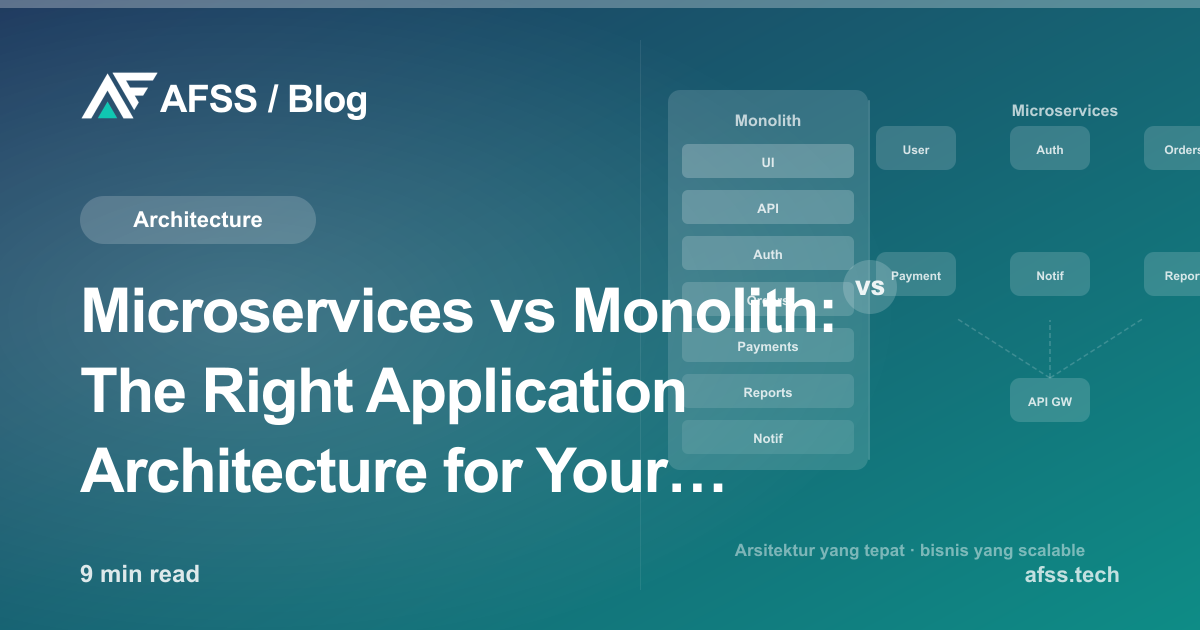
When a startup begins building a digital product, it almost always starts with a monolith architecture — one large application that handles everything. But as the business grows and the team gets bigger, the question arises: is it time to switch to microservices?
This decision isn't easy and has a major impact on development speed, operational cost, and system scalability. This article covers both in depth so you can choose wisely.

What Is Monolith Architecture?
A monolith is an application built as a single unit. All components — UI, business logic, database access, notifications, reporting — run within the same process and are deployed together.
Imagine a monolithic e-commerce application: when you change the checkout feature, you have to redeploy the entire application — including parts you didn't touch at all.
Advantages of Monolith
1. Simple to start with One repository, one deployment, one development environment. Onboarding new developers is much easier since they don't need to understand a complex service network topology.
2. Better performance for internal operations Communication between components happens in-memory (in-process), not over the network. There's no HTTP overhead or data serialization.
3. Easier testing End-to-end testing on a monolith is simpler because all components run in a single process. You don't need to spin up 10 different services just to run the test suite.
4. Lower infrastructure cost One server or a few servers to deploy a single application — much cheaper than orchestrating dozens of independent services.
Disadvantages of Monolith
- Limited scaling: You have to scale the entire application, not just the part that needs more resources.
- Risky deployments: One bug can bring down the whole application.
- Growing codebase: Over time, a monolith can become a "big ball of mud" that's hard to understand.
- Locked-in technology: The entire application must use the same language and framework.
What Is Microservices?
Microservices is an architectural approach where an application is broken down into small, independent services, each responsible for one specific business function, communicating through APIs or a message queue.
Example of an e-commerce app built with microservices:
- User Service — authentication and user profiles
- Product Service — catalog and product management
- Order Service — order processing
- Payment Service — payment integration
- Notification Service — email, SMS, push notifications
- Analytics Service — reporting and BI
Each service can be deployed, scaled, and developed independently.
Advantages of Microservices
1. Granular scalability Only the parts that need more resources have to be scaled. If the Payment Service gets a traffic spike, you scale just that service — not the entire application.
2. Independent deployment The team working on checkout doesn't need to coordinate with the team working on analytics. They deploy whenever they want without waiting on other teams.
3. Higher resilience If the Notification Service goes down, users can still make purchases. A failure in one service doesn't have to bring down the entire system.
4. Technology flexibility Each service can use whatever programming language and database fits best. The User Service can use PostgreSQL, the Product Service MongoDB, the Order Service MySQL — all valid.
5. Independent teams Each team owns its own "bounded context" — fully responsible for one business domain, from development through production.
Disadvantages of Microservices
- High operational complexity: Managing dozens of services requires mature DevOps practices — container orchestration, service discovery, distributed tracing.
- Network overhead: Communication between services over the network is slower and can fail.
- More complex testing: Integration testing requires the entire set of services to be running, which is harder to manage.
- Harder data consistency: There can't be an ACID transaction spanning multiple services.
- Higher infrastructure cost: Every service needs its own deployment, monitoring, and logging.
Direct Comparison: 7 Critical Dimensions
1. Initial Development Speed
Monolith wins. A team can build features right away without worrying about service boundaries, API contracts, or network topology. For an MVP and finding product-market fit, this speed is invaluable.
2. Long-Term Scalability
Microservices win for applications with high, unevenly distributed traffic. Microservices allow for very targeted, efficient scaling.
3. Development Cost
Monolith is cheaper early on. Microservices require a large upfront investment in infrastructure (Kubernetes, service mesh, API gateway, distributed tracing) before the team can even become productive.
4. Reliability
Microservices are more resilient in theory, but only if implemented correctly (circuit breakers, retry logic, bulkheads). A poorly implemented microservices architecture can actually be more fragile than a well-built monolith.
5. Speed with Large Teams
Microservices allow larger teams to work in parallel without conflicts. With a monolith, 50 developers working in one repository often get in each other's way.
6. Debugging and Monitoring
Monoliths are easier to debug because all logs live in one place. Microservices require distributed tracing (Jaeger, Zipkin) to track requests that cross multiple services.
7. Operational Cost
Monoliths are cheaper in terms of infrastructure. Microservices require more servers, load balancers, container registries, and monitoring tooling.
When to Choose Monolith?
A monolith is the right choice when:
- The team is small (< 10 developers) — the coordination overhead of microservices isn't worth it
- It's a new product or MVP — validating the idea matters more than scalability
- The business domain isn't clear yet — service boundaries are hard to draw when the domain isn't well understood
- Budget is limited — microservices infrastructure costs are significant
- Traffic is still low — there's no need for granular scaling
Many successful unicorn startups started with a monolith: Shopify, Stack Overflow, Basecamp — all still run as a monolith or "modular monolith" even after reaching billions of users.
When to Switch to Microservices?
Consider microservices when:
- Your developer team exceeds 20 people and keeps getting in each other's way on one codebase
- Different parts of the system need different scaling — for example, payments need 10x more instances than other features
- The business domain is already clear and the team can map bounded contexts accurately
- High availability is required — some parts must reach 99.99% uptime
- Different technologies are needed per domain (ML models in Python, real-time features in Go, etc.)
The Modular Monolith Approach: The Sweet Spot
There's a third approach that's often overlooked: the Modular Monolith. This is a monolith built with strict module boundaries — essentially microservices within a single process.
Example directory structure:
src/
  modules/
    users/         ← users domain, only accessible via interface
    products/      ← products domain, isolated
    orders/        ← orders domain
    payments/      ← payments domain
  shared/          ← utilities that can be used across modules
The benefit: when it's time to migrate to microservices, each module can be extracted into an independent service with minimal changes. This is a strategy recommended by many engineering leaders for growing applications.
Migration Guide: Monolith to Microservices
If your application has already grown into a large monolith and needs to migrate, follow the Strangler Fig Pattern:
- Identify domains with different scaling needs — usually Payment, Notification, or the feature that changes most often
- Build the new service alongside the monolith — don't refactor the monolith
- Redirect traffic to the new service via an API gateway or feature flag
- Retire the corresponding piece of the old monolith once the new service is stable
- Repeat for the next domain
This process can take 12-24 months for large applications. Do it incrementally, not all at once.
Relevant Technologies
For Monolith
- Framework: Next.js, Django, Laravel, Spring Boot, Ruby on Rails
- Database: PostgreSQL, MySQL
- Deployment: Single server VPS, managed app platform
For Microservices
- Container: Docker
- Orchestration: Kubernetes, Docker Swarm
- API Gateway: Kong, AWS API Gateway, Nginx
- Service Mesh: Istio, Linkerd
- Message Queue: RabbitMQ, Apache Kafka
- Distributed Tracing: Jaeger, Zipkin, OpenTelemetry
- Monitoring: Prometheus + Grafana, Datadog
Conclusion
There's no universal answer. A monolith isn't "primitive" and microservices aren't "modern" — they're different trade-offs for different problems.
A simple guide:
- New business, small team → Modular Monolith
- Proven product, team > 20 people, scaling becomes an issue → Gradual migration to Microservices
- Enterprise with very clear domains → Microservices from day one
At AFSS, we help design the architecture that fits your business's stage and needs — not whatever happens to be trending. Get a free consultation to discuss your application architecture.
Have a similar project?
Free consultation, no commitment. Tell us what you need — we'll help you find the best solution.
Free Consultation