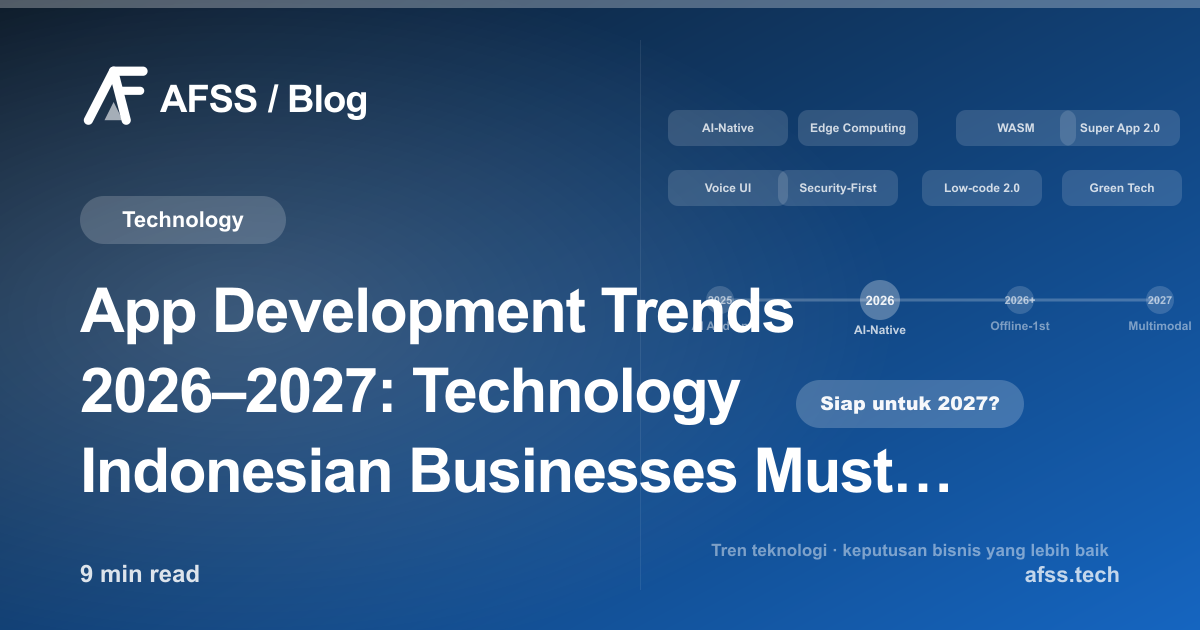
App Development Trends 2026–2027: Technology Indonesian Businesses Must Understand
Every 18–24 months, there's a significant shift in how applications are built and used. In 2024–2025, that shift was dominated by generative AI. In 2026–2027, this trend is maturing further, and several new trends are emerging that will reshape industry standards.
This article isn't about hype. It's about trends that have already proven their direction and will have a real impact on how Indonesian businesses build and use applications over the next 12–24 months.
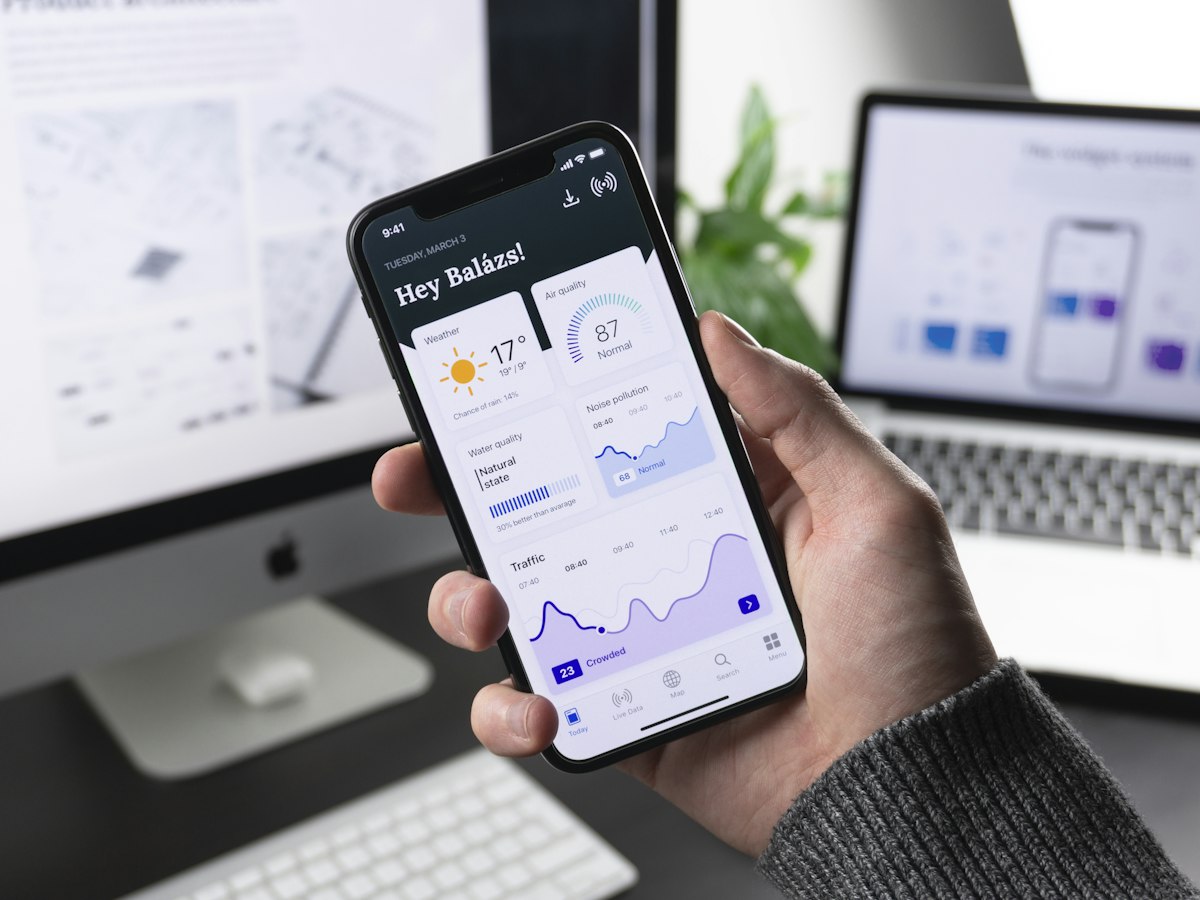
1. AI-Native Applications: AI as the Foundation, Not an Add-On Feature
The first stage of AI adoption in business applications (2023–2025) was AI as an add-on: a chatbot stuck in the corner of the screen, a skippable summarize feature, or auto-complete that occasionally popped up.
The 2026–2027 trend is fundamentally different: AI becomes a core layer of the application, not an optional feature. This means:
- Adaptive interfaces: UI that changes based on each user's habits — showing frequently used menus more prominently, hiding ones never used
- Proactive insights: The app doesn't just display data, it provides action recommendations based on that data ("Product A's stock will run out in 3 days based on sales trends — want to create a purchase order now?")
- Natural language queries: Users can "ask" the system in natural language instead of filling out forms or navigating complex menus
- Predictive workflows: The system anticipates the next step and prepares it before the user asks
For Indonesian businesses, this means the standard of user expectations for B2B applications (ERP, CRM, inventory) will rise significantly. Apps that aren't "smart" will feel outdated.
2. Offline-First & Edge Computing: Performance Anywhere
Indonesia has a unique connectivity challenge: even in major cities, internet connections can be unstable. In industrial areas, warehouses, and the field, connections often drop.
The offline-first development trend addresses this: applications are designed to work fully without internet, with synchronization happening in the background when a connection is available.
Technologies supporting this:
- Progressive Web Apps (PWA) with service workers that store data locally
- CRDTs (Conflict-free Replicated Data Types) for conflict-free data synchronization
- SQLite in the browser (an evolution of WebSQL) for a powerful local database
- Edge computing: processing happens on the device or nearest server, not in a central cloud
Business implications: field apps for sales teams, couriers, technicians, and drivers will become increasingly reliable in areas with limited connectivity.
3. Super-App Evolution: From All-in-One to Ecosystem Play
The super app model — one app that does everything — has proven successful in China (WeChat, Alipay) and is starting to be adopted in Southeast Asia (Gojek/GoTo, Grab).
The 2026–2027 trend is super app 2.0: not one company building every feature, but a platform that lets other businesses "open a shop" inside it as mini-apps.
For Indonesian businesses:
- SMEs can join a super app ecosystem without building an app from scratch — just create a mini-app
- Enterprises can build an internal super app that integrates all the tools employees use: attendance, approvals, reports, chat, document access — all in one interface
- B2B SaaS can expand distribution by offering their product as a module that can be integrated into other business platforms
4. Voice & Multimodal UI: Beyond Screen Taps
Voice-based interfaces aren't new, but combined with generative AI, they create something qualitatively different.
The new generation of voice UI understands conversational context and natural language (including Indonesian with various accents and dialects), and can execute complex workflows based on voice instructions.
Use cases that will become increasingly common in Indonesian businesses:
- Warehouse management: Warehouse workers can log incoming goods or report damage by voice without stopping their work
- Field service: Technicians can update job status or request instructions by voice while working
- Call center: AI that can fully handle first-line customer service calls for standard questions
Multimodal UI — a combination of text, voice, images, and gestures — will become the new standard. Users can photograph a document, ask about its contents, and the system acts on it immediately.
5. WebAssembly (WASM): Desktop Performance in the Browser
WebAssembly allows code written in languages like Rust, C++, or Go to run in the browser with near-native performance. This opens up possibilities that weren't previously available on the web:
- Video editing directly in the browser without installing software
- Analysis of large datasets (millions of rows) running in real time
- Games and simulations requiring high performance
- Design or CAD tools that used to only run on desktop
For Indonesian businesses, the implication is that web applications can replace expensive desktop software — complex ERP reports, financial analysis, supply chain simulation — all running in the browser without installation.

6. Security by Design: Security Isn't an Afterthought
Cyberattacks on Indonesian businesses have increased more than 100% over the last 3 years. The global trend is a shift from "security as a feature" to "security by design" — security built in from the architecture level, not added after the app is already built.
Standards that are becoming a common expectation:
- Zero-trust architecture: Nothing is trusted by default, all access is verified at all times
- End-to-end encryption for sensitive customer data
- Automated vulnerability scanning integrated into the development pipeline
- Compliance as code: Security rules and regulations (PDPA, ISO 27001) implemented in code, not just documented on paper
For businesses building or upgrading applications, this means choosing a development partner that understands and applies security best practices — not just one that "makes it work."
7. Green Tech & Sustainable Software
Awareness of technology's environmental impact is starting to factor into business decisions:
- Major cloud providers are starting to offer carbon footprint reports per workload
- More efficient algorithms are becoming a competitive advantage (cheaper and "greener")
- Corporate users are starting to question the sustainability practices of their technology vendors
For Indonesian developers and technology vendors, this is still a longer-term trend — but for businesses serving multinational clients or wanting to strengthen their ESG reporting, it's already relevant today.
8. Low-Code 2.0: Platforms That Are Truly Developer-Grade
The first generation of low-code (2018–2023) was good for prototypes and simple applications but often hit its limits as complexity requirements grew. Low-code 2.0 is different:
- AI-assisted development that can generate production-ready code from natural language descriptions
- Full extensibility with the ability to write custom code when needed
- Enterprise grade — multi-tenant, role-based access, audit trail, compliance
- Integration fabric natively connected to hundreds of enterprise systems
Implication: business application development cycles can be cut by 40–60%, and more technical decisions can be made directly by business teams without an IT bottleneck.
What Does This Mean for Indonesian Businesses?
These trends aren't something to worry about "later." Some things should already be considered now:
- If you're building or renovating an application, make sure the architecture allows for AI integration without needing a rebuild from scratch — API-first design, modular components
- If you have a field team working in areas with weak signal, offline-first isn't a luxury but a necessity
- If you handle customer data, security by design must be a requirement, not an option
- If you're considering low-code, evaluate a genuinely enterprise-grade new-generation platform — not a first-generation one with limits you won't notice until it's too late
The best technology is the right technology for your needs — not the newest or most expensive. What matters most is understanding these trends early enough to make the right decisions.
At AFSS, we build applications with scalability and adaptability to technology change in mind — not just today's needs. Get a free consultation about your business application's technology roadmap.
Have a similar project?
Free consultation, no commitment. Tell us what you need — we'll help you find the best solution.
Free Consultation