As a business grows, data ends up scattered everywhere: stock in Excel, finances in a ledger, attendance in yet another app. ERP (Enterprise Resource Planning) brings all of this together into one integrated system.
What is ERP?
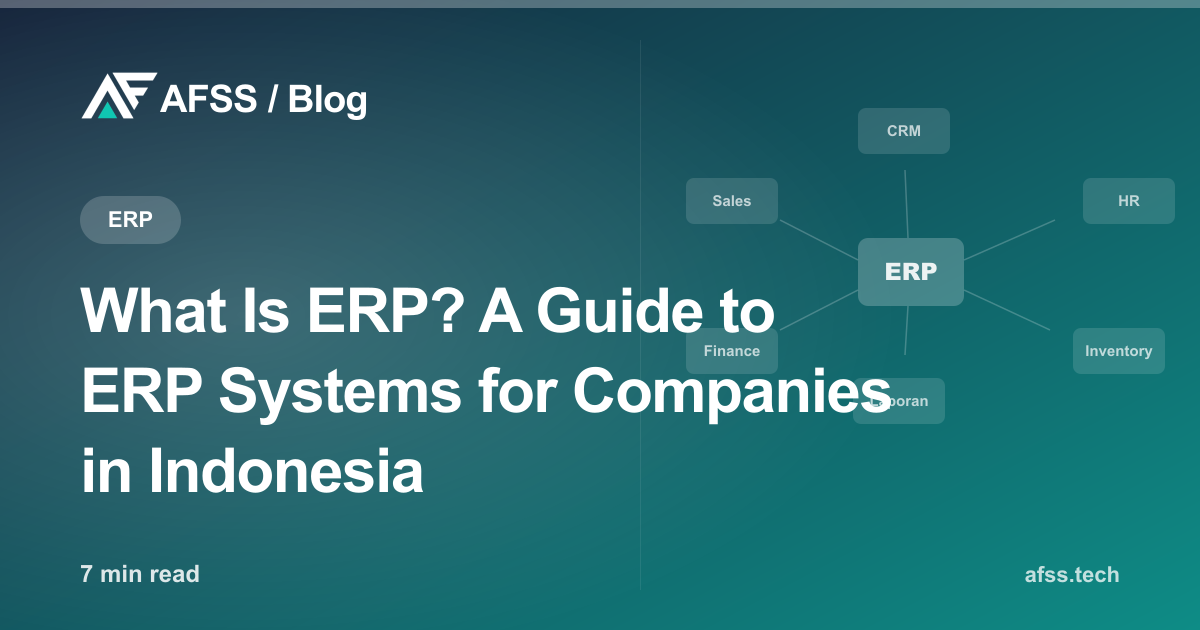
ERP is a system that manages and connects a business's core processes — finance, inventory, procurement, sales, and HR — so all data flows into one place and reporting becomes real-time.
Modules commonly found in ERP
- Finance & Accounting — record-keeping, profit and loss statements, balance sheets.
- Inventory — stock in and out, multi-warehouse tracking.
- Purchasing & Sales — purchase orders, invoices, customer records.
- HR & Payroll — employee data, attendance, payroll processing.
- Reporting — dashboards and analytics across departments.
Signs your business needs ERP
- Data is scattered across many files/apps and often out of sync.
- Monthly reports take days to put together.
- Manual input errors happen often.
- Your team struggles to see the real-time state of the business.
If several of these sound familiar, ERP can dramatically cut down your operational overhead.
Off-the-shelf ERP vs custom ERP
Off-the-shelf ERP is quick to set up but often doesn't fit your actual business workflow. Custom ERP is built around your company's real processes — a better fit, and the code is yours. To decide, weigh the complexity and uniqueness of your workflow — similar to the considerations in custom website vs template.
Start with what you actually need
You don't have to build everything at once. We typically build ERP systems in stages, starting with the most urgent modules. See our custom ERP development services or request a quote.
Have a similar project?
Free consultation, no commitment. Tell us what you need — we'll help you find the best solution.
Free Consultation