There's one number every business owner should remember: acquiring a new customer costs 5-7x more than retaining an existing one. Yet most businesses spend far more time and money on acquisition than on retention.
An effective loyalty program flips this equation. And in 2026, a loyalty program that truly works has to take the form of a digital app — no longer a physical stamp card that's easily lost and provides zero data.
Why Are Digital Loyalty Programs Far More Effective?
Physical stamp cards have fundamental limitations:
- No customer data — you don't know who's using it, how often, or what they're buying
- Easily lost — cards get misplaced, customers forget to bring them
- Can't be personalized — every customer gets the same treatment
- Can't be analyzed — no insight for improving the program
A digital loyalty app solves all these problems at once. Plus, a smartphone is always in someone's pocket — customers don't need to carry a separate card.
Additional benefits of a loyalty app:
- Push notifications — remind customers when points are about to expire, there's an exclusive promo, or they haven't visited in a while
- Personalization — different offers for VIP customers vs. new customers
- Gamification — badges, levels, and leaderboards make the experience more engaging
- Omnichannel integration — points from offline, online, and in-app purchases are all counted together
Types of Loyalty Program Models
Choose the model that fits your business's characteristics:
1. Points-Based
The most common and easiest model for customers to understand. Every purchase earns points that can be redeemed for rewards.
Best for: Retail stores, restaurants, salons, pharmacies How it works: Spend Rp 10,000 = 1 point; 100 points = Rp 5,000 discount Advantages: Easy to understand, encourages repeat purchases Challenges: Can feel "transactional" without an emotional element
2. Tiered Membership
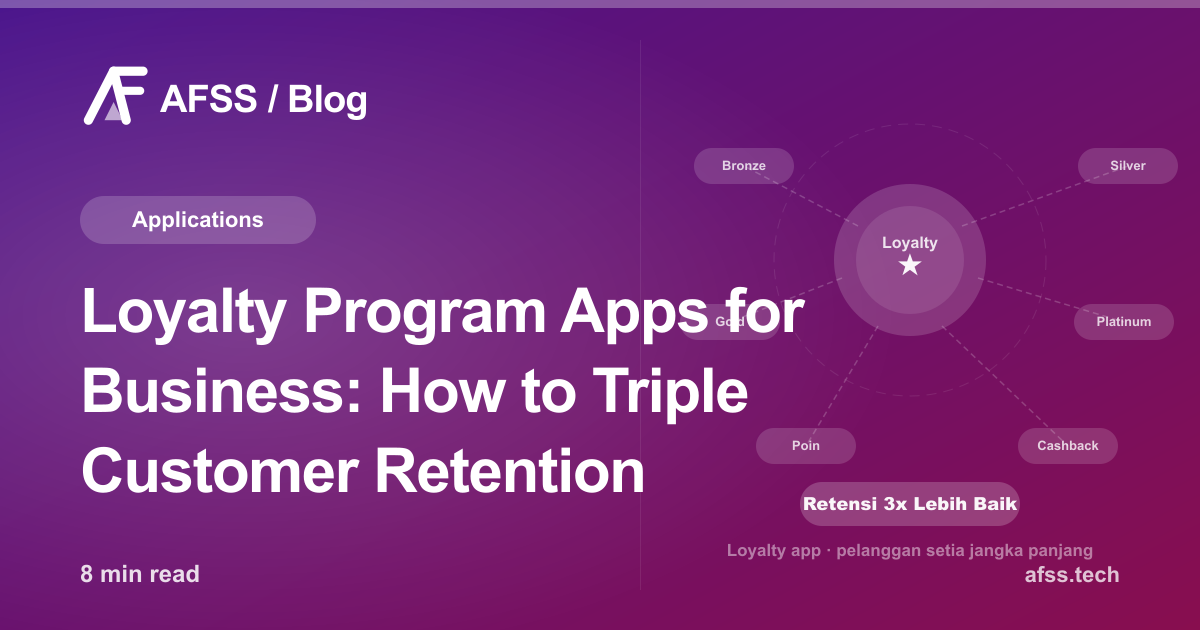
Customers move up levels based on cumulative spending: Bronze → Silver → Gold → Platinum. Each level gets better benefits.
Best for: Hotels, airlines, fashion brands, premium coffee shops How it works: Total spend Rp 1M = Silver (10% discount); Rp 5M = Gold (20% discount + priority service) Advantages: Creates aspiration and status; high-tier customers feel valued Challenges: Benefits need to feel genuinely significant at every tier
3. Cashback
A percentage of every purchase is returned as credit that can be used for the next purchase.
Best for: E-commerce, marketplaces, fintech How it works: Every transaction earns 2-5% cashback into a digital wallet Advantages: The incentive value feels immediate and tangible Challenges: Business margins need to be sufficient to cover the cashback
4. Digital Punch Card / Stamp
A digital version of the stamp card. Buy X times, get one free.
Best for: Coffee shops, bakeries, laundromats, barbershops How it works: Buy 9 coffees = the 10th one is free Advantages: Very simple to understand and implement Challenges: No reward variation, easy to "game" with a minimum purchase
5. Subscription Loyalty
Customers pay a subscription fee for exclusive benefits.
Best for: Brands with high-frequency customers How it works: Pay Rp 50,000/month = free shipping on all orders + 15% discount every week Advantages: Predictable revenue; committed customers Challenges: Benefits need to be clear and easy to calculate
Must-Have Features of an Effective Loyalty App
Not all loyalty apps are created equal. Here are the features that set truly effective loyalty apps apart:
Customer Dashboard
- Current point balance or tier status
- Transaction and points-earning history
- How to redeem rewards
- Progress toward the next tier
Smart Notifications
Not just spam — personalized notifications like:
- "You have 120 points, enough for a Rp 20,000 discount — valid until the end of the month!"
- "Hi [Name], it's been 30 days since your last visit. We have a special treat for you!"
- "Spend Rp 50,000 more to reach Gold level"
An Engaging Reward Catalog
Don't just offer discounts. Diversify your rewards:
- Free products
- Service upgrades
- Early access to new products
- Exclusive experiences (dinner with the chef, a factory tour)
- A charity donation made in the customer's name
Referral Program
Integrate a referral program: customers who refer friends earn bonus points. Measurable digital word-of-mouth.
POS and E-commerce Integration
Points need to accumulate across every purchase channel — in-store (via QR scan or phone number entry), on the website, and in the app. Customers shouldn't feel like any one channel is "more rewarding" than another.

Data Insight: Measurable Loyalty Program ROI
A loyalty program isn't a cost — it's a measurable investment. Metrics you should track:
Customer Retention Rate (CRR): The percentage of customers who return within a given period. Retail industry benchmark: 40-60%. Target with a good loyalty program: 65-75%.
Customer Lifetime Value (CLV): Total revenue from one customer over their active lifetime. Customers with a loyalty membership typically have a CLV 3-5x higher.
Purchase Frequency: How often customers buy. Well-timed notifications from a loyalty app can boost this frequency by 20-40%.
Average Order Value (AOV): Loyalty customers tend to add extra items to reach a points threshold or the next tier.
Case Study: A Local Minimarket Chain in Bandung
A local minimarket chain with 8 branches in Bandung implemented a simple loyalty app: points-based with cashback and membership tiers.
Initial investment: Rp 35M for app development + Rp 5M/month for maintenance and servers.
Results after 6 months:
- 12,400 registered users (25% of their average monthly transactions)
- Purchase frequency among loyalty members rose 34% vs. non-members
- Average basket size for loyalty members was 22% higher
- Customer acquisition cost via app referrals: Rp 8,000/customer vs. Rp 45,000/customer from ads
They reached break-even by month 5. In the first year, the loyalty app's ROI hit 280%.
Steps to Building a Loyalty Program App
Define your business goal: Are you focused on frequency, AOV, referrals, or churn prevention? A clear goal determines the right mechanics.
Choose the right reward model: Don't copy other brands without analysis. What actually makes your customers happy to come back?
Calculate the program's economics: How much will the rewards cost? Make sure margins stay healthy — typically program costs run 1-3% of revenue generated by members.
Design a simple UX: Users should be able to understand how the program works within the first 30 seconds of using the app.
Plan your communication strategy: How will the program be communicated to current customers? How will new members be onboarded?
Set KPIs and review regularly: Evaluate every month — which notifications get a response, which rewards get redeemed most, which tier level has the most drop-off.
How Much Does It Cost to Build a Loyalty App?
It depends on complexity:
- A simple loyalty program (points + punch card, Android): starting from Rp 15-25M
- Loyalty + tiers + push notifications (Android + iOS): Rp 25-45M
- Full-featured loyalty + POS integration + analytics dashboard: Rp 45-80M
Remember: compare this to your monthly advertising spend. If ads cost Rp 5M/month for acquisition, a loyalty app that breaks even by month 6 and keeps working for years is a far more efficient investment.
AFSS builds loyalty apps that aren't just good-looking, but designed from the ground up to drive the purchasing behavior you want. Get a free consultation about a loyalty app for your business.
Have a similar project?
Free consultation, no commitment. Tell us what you need — we'll help you find the best solution.
Free Consultation