Garment Production Management App: Tracking Konveksi Output from Cutting to Quality Control
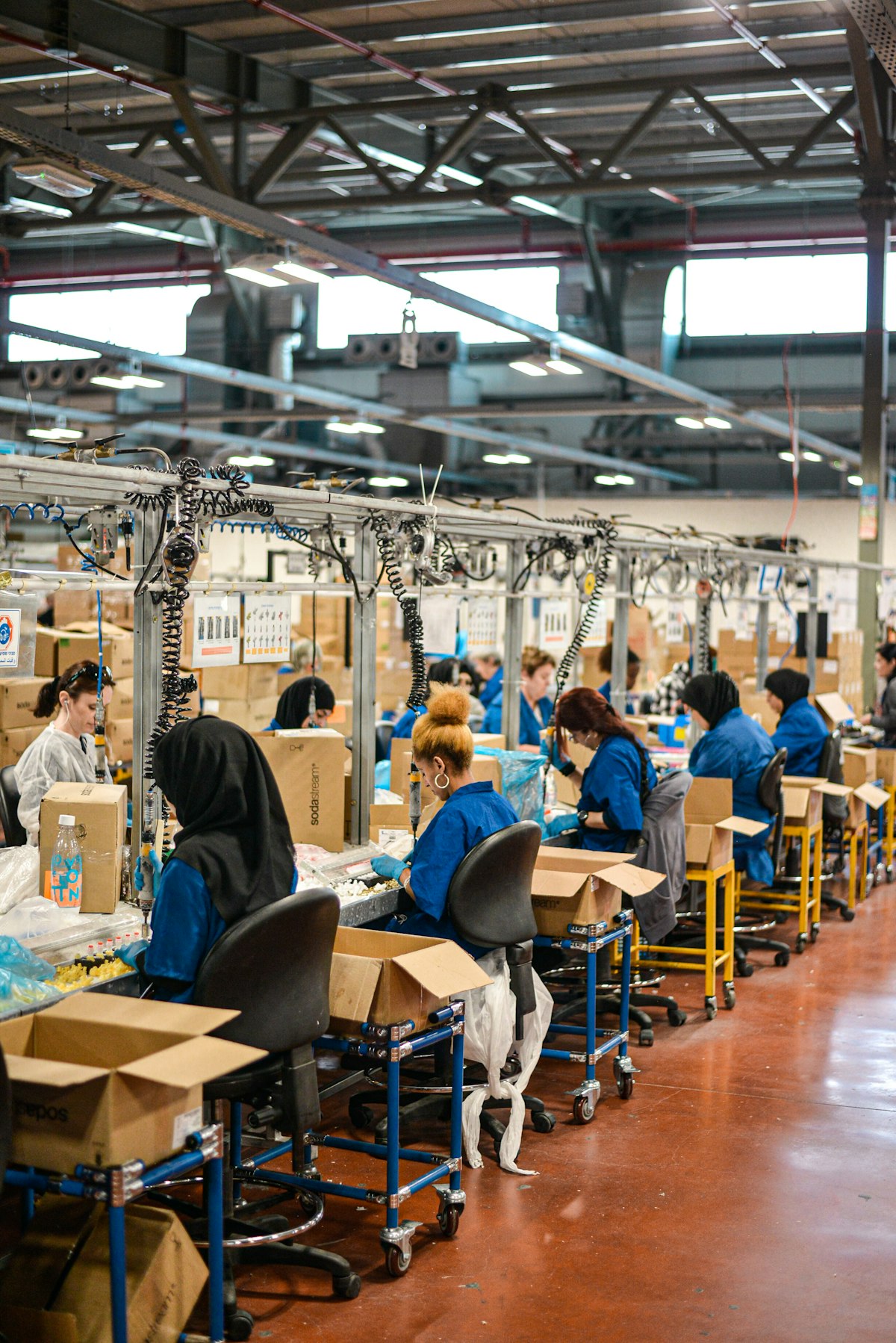
Pak Dedi Kurniawan started a garment workshop called Kurnia Jaya Konveksi in Cimahi, West Java, back in 2011, beginning with 8 sewing machines in his home garage and growing into an operation with 65 workers across three production lines: cutting, sewing, and finishing/quality control. Every morning, line supervisors write daily targets and progress on a large whiteboard mounted on the factory wall -- how many dozens have been cut, how many have entered sewing, how many have been finished. Updates from the production floor flow through a WhatsApp group called "Produksi KJK" with 12 members, where supervisors send photos of the whiteboard and short messages like "line 2 only at 40%, running low on fabric." Piece-rate wages are calculated manually by the admin every Saturday, matching each worker's paper production card against the rate-per-piece written in a rate book. Stock of fabric, thread, and buttons is recorded in a warehouse ledger, updated whenever goods come in or out -- but entries often lag because the warehouse head juggles other duties too.
The problem became painfully real in March 2026, when Kurnia Jaya Konveksi received a large order from PT Retailindo Nusantara for 5,000 uniform shirts worth Rp375 million, with a 30-working-day deadline and a contract clause imposing a 1% penalty of the contract value per day of delay. On paper, everything looked on track -- the whiteboard showed sewing progress at 60% by day 20. But that figure was never broken down by line, and no one noticed that line 2 had stalled since day 12 after three senior sewers resigned unexpectedly and their replacements had not yet reached normal speed. The gap between lines only became visible on day 25, when the admin manually compiled a report for the buyer and found line 2 had completed just 35% of its target, far behind lines 1 and 3. Frantic overtime could not close the gap in time. The order was finally shipped 8 days past deadline, triggering a Rp30 million late penalty (1% x Rp375 million x 8 days), plus roughly Rp18 million in emergency overtime costs to add night shifts in the final week. This combined Rp48 million loss nearly wiped out the order's projected margin of Rp56 million. PT Retailindo Nusantara also indicated it would reconsider the partnership for future orders. Ironically, had the bottleneck on line 2 been detected as early as day 12, Pak Dedi would have had enough time to rotate workers between lines or bring in freelance piece-rate operators before the delay became unavoidable. This situation is common among mid-size garment workshops in Indonesia that still rely on whiteboards, WhatsApp groups, and manual ledgers to manage production across multiple stages.
What Is a Garment Production Management App
A garment production management application is a digital system that integrates the entire apparel manufacturing workflow -- from receiving buyer orders and planning raw material requirements, to tracking progress at each production stage (cutting, sewing, finishing, quality control), to calculating workers' piece-rate wages -- in a single platform accessible in real time by the owner, admin, line supervisors, and warehouse staff. Unlike generic point-of-sale apps or Excel spreadsheets that only record one-directional transactions, this kind of system is purpose-built to map every production unit (a fabric cut, a bundle, or a dozen pieces) as it moves through multiple work stages, each with a different person responsible and a different time target.
With a system like this, the incident that hit Kurnia Jaya Konveksi could have been prevented from the start. Every production line has its own progress dashboard that updates every time a bundle moves to the next stage -- not one manually compiled once a day. The moment line 2's progress starts falling behind its daily target, the system automatically alerts the admin and owner well before the delay becomes unavoidable, giving them room to take corrective action such as rotating labor or adding a shift earlier.
The Real Cost of Running a Garment Workshop Without a Centralized System
- Production bottlenecks go undetected until it's too late. Without real-time stage-by-stage progress tracking, a delay on one line only becomes visible once it is too late to correct, as Kurnia Jaya Konveksi experienced with a Rp48 million loss.
- Raw material stock runs out mid-production without warning. Manual warehouse ledgers are often updated late, so fabric, thread, or buttons can suddenly run out and halt a production line during the reordering process.
- Piece-rate wage disputes erode worker trust. Manual calculation from paper production cards is prone to errors or discrepancies, triggering worker complaints and risking skilled workers leaving for another workshop.
- No visibility into deadlines across buyer orders. When several buyer orders run simultaneously, it is hard to prioritize the most urgent one without a centralized dashboard, raising the risk of repeated late penalties.
- Reject rates go unmonitored per line or per worker. Without structured defect data, the owner cannot identify which line or worker needs additional training, so rework costs keep recurring without the root cause ever being fixed.
Key Features Every Garment Management App Needs
- Production order tracking per stage. Every bundle or dozen is tagged with its status -- cutting, sewing, finishing, quality control -- so progress on every line is visible in real time, not compiled manually at the end of the day.
- Raw material stock management with per-order usage tracking. Fabric, thread, and buttons are automatically allocated to specific orders based on pattern requirements, with low-stock alerts before production grinds to a halt.
- Automatic piece-rate wage calculation. The system logs how many pieces each worker completes per stage and calculates wages according to the piece rate automatically, eliminating disputes caused by manual miscalculation.
- Deadline dashboard per buyer order. All active orders are displayed with time remaining, progress percentage, and a delay-risk indicator, so priorities can be adjusted before problems escalate.
- Reject rate tracking per line and per worker. Every unit that fails quality control is logged with the defect type and the person responsible, generating data usable for performance evaluation and targeted training.
- Automatic bottleneck notifications. The system compares actual progress against daily targets per line and sends an alert the moment a line falls behind, before delays pile up the way line 2 did at Kurnia Jaya Konveksi.
- Production and profitability reports per order. The owner can see the real margin on each buyer order after accounting for raw material costs, piece-rate wages, and rework costs from rejects.
Buy an Off-the-Shelf App or Build a Custom System
For home-based or small-scale workshops with one or two production lines and relatively uniform orders, a generic subscription-based app is usually sufficient. Standard features like basic order and stock recording typically cover the essentials without requiring a large upfront investment.
But once a workshop runs many parallel lines, handles complex product variation (a mix of shirts, pants, and uniforms with different patterns, for instance), or takes on mid-to-large buyer order volumes like the PT Retailindo Nusantara case, a custom system becomes far more valuable. Generic apps usually cannot adapt to a workshop's specific production stage flow (a different work sequence for knit versus woven products, for example), do not support tiered piece-rate wage schemes, and are hard to integrate with the accounting or B2B e-commerce systems already in use. Mid-size garment workshops in Indonesia handling multiple corporate buyers with different contracts generally benefit more from a system built around their own workflow.
Cost and Timeline Ranges in Indonesia
Generic subscription-based apps typically range from Rp300,000 to Rp1.5 million per month depending on the number of users and features. For a mid-scale custom system covering per-stage production tracking, raw material stock, and piece-rate wages, development costs range from Rp45 million to Rp120 million with a 3-5 month build time. For large-scale workshops with many lines, full ERP integration, and per-order profitability analytics modules, costs can reach Rp150 million to Rp350 million with a 5-8 month build time. Beyond the initial development cost, budget for annual maintenance of around 15-20% of the development cost for system updates, bug fixes, and technical support.
Case Study: Konveksi Mandiri Sejahtera
As an illustrative composite of several similar implementations, a fictional workshop called Konveksi Mandiri Sejahtera, with four production lines and 90 workers, implemented a custom production management system at the start of the year. Before implementation, an average of two out of every ten buyer orders shipped late each month, with average late penalties of Rp15 million per month. Six months after the system went live, late orders dropped to fewer than one in ten per month, as line-level bottlenecks were detected an average of 6 days earlier than before. The reject rate fell from 4.2% to 2.1% after the owner identified the two workers with the highest stitching defect rates and provided them targeted retraining. The weekly piece-rate wage reconciliation that used to take a full day now finishes in under an hour.
Metrics to Monitor After Implementation
- Percentage of orders shipped on time, ideally above 95% once the system is running stably.
- Bottleneck detection time, measured as the gap between when a line's progress starts falling behind and when the system flags the issue.
- Reject rate per line and per worker, monitored monthly to identify training needs.
- Piece-rate wage calculation accuracy, measured by the number of worker complaints about wage discrepancies per pay period.
- Frequency of sudden raw material stockouts, ideally near zero once the stock alert system is running.
Implementation Challenges and How to Overcome Them
The first challenge is resistance from line supervisors and workers who have relied on whiteboards and manual logs for years. The solution is to involve line supervisors from the system design stage, keep floor-level data entry simple (scanning a bundle barcode, for instance, rather than complex manual data entry), and run the new system in parallel with the old method for the first 2-4 weeks before fully switching over.
The second challenge is initial data quality, especially for raw material stock and piece-rate wage tables per product type that have been scattered across various notebooks. Before going live, conduct a full stock opname and consolidate all piece rates into a single master data set, so the new system does not inherit inaccuracies from the old one.
The third challenge is unstable internet connectivity on the production floor, especially in factory buildings with thick concrete structures. Choose a system that supports offline-first data entry on the floor, with automatic sync once connectivity returns, so progress logging doesn't stop just because WiFi signal is weak in a particular corner of the factory.
Where to Start
Every month a workshop keeps relying on whiteboards and WhatsApp groups to track production, the risk of an incident like the one Kurnia Jaya Konveksi experienced -- a Rp48 million loss from a single order -- keeps repeating, and each repetition erodes corporate buyer trust a little further. The first step you can take now is to count how many late deliveries or piece-rate wage disputes occurred in the last 6 months, and tally the total losses from late penalties and emergency overtime costs -- this number is usually the most concrete reason to start investing in a better system. AFSS builds custom production management systems tailored to each client's specific workshop workflow, not a generic template forced to fit. Check the pricing or go straight to submit a project to discuss your garment production system needs.
Have a similar project?
Free consultation, no commitment. Tell us what you need — we'll help you find the best solution.
Free Consultation
Refillable Water Depot Management Software: Solving Deposit Gallons, Subscriptions, and Delivery Routes
Read more
Senior Care Facility Management App: Medication Schedules, Care Plans, and Family Communication
Read more