Why Your Business Needs a Mobile App in 2026 — Not Just a Website
Indonesia is one of the largest mobile markets in Southeast Asia. With 212 million active smartphone users in 2026, investing in a mobile app is no longer a question of "if" — it's a question of "when."
But a mobile app isn't right for every business, and the wrong timing can burn through budget with nothing to show for it. This article helps you decide correctly.
Why Is a Mobile App Different from a Mobile-Friendly Website?
Many business owners think: "My website is already responsive on mobile, why build an app?"
Fair question. The answer lies in a fundamental difference in how users interact:
Mobile website:
- Accessed through a browser — requires an internet connection
- Limited experience (no access to camera, GPS, push notifications, offline data)
- No icon on the home screen — users have to remember the URL
- Can't personalize as deeply as a native app
Mobile app (native/hybrid):
- Icon on the home screen — visible every time the user opens their phone
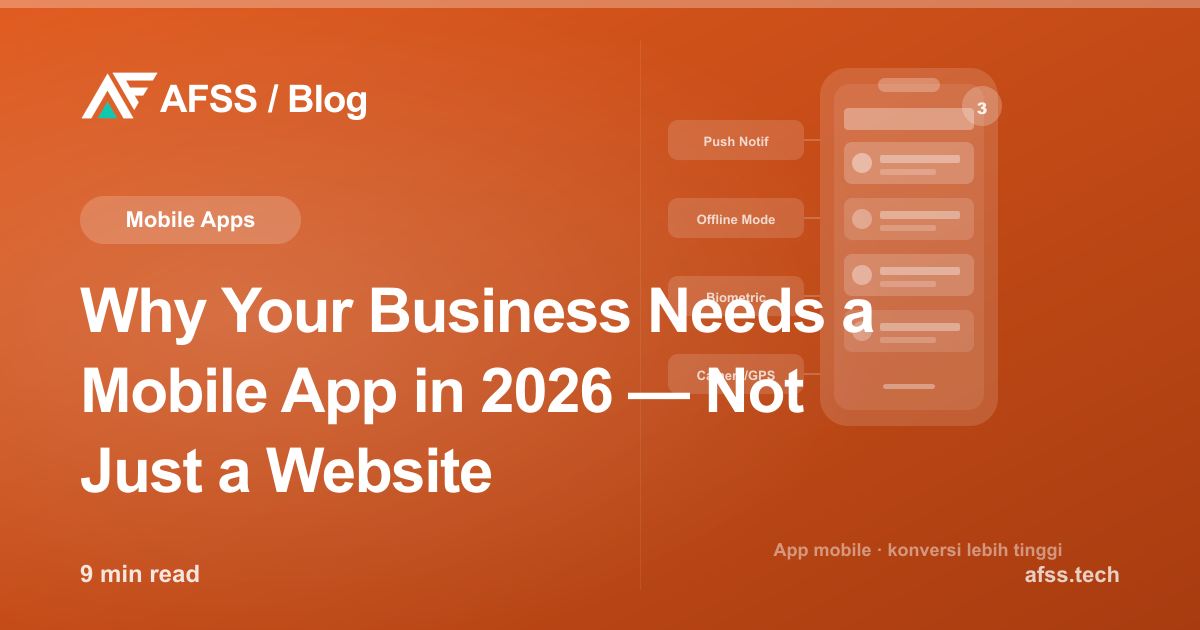
- Full access to device features: camera, GPS, biometrics, push notifications, sensors
- Can run offline or with limited connectivity
- Faster performance, smoother animations, deeper UX
- User data stored locally — a more personal experience
These differences seem small on paper, but they're significant in user behavior: on average, users spend 87% of their mobile time inside apps, not in browsers.
Signs Your Business Already Needs a Mobile App
1. Your Users Come Back Repeatedly
If customers visit your website more than 2-3 times a week, they're ideal candidates for app users. High frequency = high value from push notifications and a better experience.
Example: a restaurant with a loyalty program, an online store with repeat customers, or a service platform whose customers book regularly.
2. You're Losing Customers to Checkout Friction
On a mobile website, every checkout step is a chance for drop-off. Users have to retype data, wait for pages to load, and deal with browsers that store cookies inconsistently.
In an app, this process can be:
- Auto-filled from a saved profile
- One-tap payment via GoPay, OVO, Dana, or QRIS
- Biometric authentication (fingerprint/face ID) for frictionless security
- Checkout in 3 steps vs. 8 steps on a website
McKinsey research shows mobile app checkout has a 2.5x higher conversion rate than mobile web for e-commerce categories.
3. Internal Operations Are Still Manual or Run via WhatsApp
Mobile apps aren't just for customers. Many businesses need an internal ops app — for field teams, drivers, salespeople, or technicians who need real-time data access without opening a laptop.
Example: an app for field sales reps to enter orders directly from their phone, or an app for technicians to receive job orders and update work status.
4. You Want to Build Loyalty, Not Just Transactions
Push notifications are a superpower that websites don't have. With user permission, you can send:
- Limited-time promos relevant to purchase history
- Appointment or schedule reminders
- Real-time order status updates
- Educational content that builds long-term relationships
Average push notification open rate is 45-65% — far above email (20-25%) and promotional SMS (35-40%). It's the most effective business communication channel in 2026.
5. User Data Is a Strategic Asset for Your Business
A mobile app enables far richer data collection: usage patterns, favorite features, friction points, active hours, location (with permission). This data fuels data-driven business decisions.
With good analytics in your app, you know exactly:
- Which features are used most often
- Where users drop off
- What time notifications are most effective
- Which user segments are most loyal
Types of Mobile Apps for Business
1. Customer-Facing App
Goal: increase conversion, loyalty, and customer lifetime value.
Suited for: e-commerce, F&B, professional services, education, healthcare, entertainment.
Common features: product/service catalog, in-app payments, loyalty points, push notifications, live chat, transaction history.
2. Internal Operations App
Goal: field team efficiency, less manual work, accurate real-time data.
Suited for: companies with distribution teams, field sales, technicians, delivery.
Common features: job order management, GPS tracking, photo documentation, digital signatures, automated daily reports.
3. B2B / Partner App
Goal: make it easy for partners, resellers, or distributors to interact with your system.
Suited for: FMCG distributors, franchisors, companies with agent networks.
Common features: order entry, real-time stock check, sales reports, automatic commission calculation, training materials.
How Much Does It Cost to Build a Mobile App?
A question that always comes up. The answer depends on complexity:
- Simple app (catalog + contact, no backend) — starting from Rp 8-15M
- App with user accounts + database — Rp 15-35M
- E-commerce app with payment gateway — Rp 25-60M
- Enterprise app with ERP/CRM integration — starting from Rp 75M, priced per feature
The technology we recommend in 2026: React Native for businesses that need both Android and iOS on an optimal budget, or Flutter for near-native performance. For internal tools accessible via a browser, a Progressive Web App (PWA) can be a more affordable alternative.
A Realistic Development Timeline
- MVP (minimal version): 6-10 weeks
- Full e-commerce app: 12-16 weeks
- Enterprise app: 16-24 weeks or more
The most common cause of delay: feature definitions changing mid-project. The clearer the scope upfront, the more accurate the timeline and budget.
The Launch Strategy Businesses Often Overlook
Building an app is 60% of the job. The remaining 40% is launch and adoption. Many businesses fail not because the app is bad, but because there's no strategy to get users to download and actually use it.
Adoption strategies we recommend:
- Soft launch to loyal customers first — gather feedback, refine before a public launch
- Download incentives — first-purchase discounts, bonus points, or exclusive features for app users
- Multi-channel communication — email, WhatsApp blasts, and social media posts
- App Store Optimization (ASO) — compelling screenshots, keyword-optimized descriptions
- Simple onboarding — a maximum of 3 steps from download to core feature
Questions You Must Answer Before You Start
Before deciding to build an app, answer these questions:
- Who are this app's primary users, and what specific problem will it solve?
- Will users open this app more than twice a week?
- Are there features that can only be implemented in an app (notifications, camera, offline GPS)?
- How many active users are needed for this app to be "worth it"?
- Who will maintain and update the app after launch?
If the answers to questions 1-3 are strong, investing in a mobile app is well worth it. If you're unsure, start with a Progressive Web App or a highly optimized website first.
From Idea to an App Running on Your Customers' Phones
At AFSS, we handle the entire process: from feature definition and wireframes, UI/UX design, frontend & backend development, payment gateway integration (Midtrans, Xendit), submission to the Play Store & App Store, through post-launch maintenance.
All code belongs to you — not a subscription to our platform. Technical documentation is included so you can onboard other developers in the future if needed.
Want to discuss whether your business is ready for an app? Get a free consultation via WhatsApp — we'll help assess your needs and give you an honest recommendation, even if the answer is "you don't need an app yet."
Have a similar project?
Free consultation, no commitment. Tell us what you need — we'll help you find the best solution.
Free Consultation