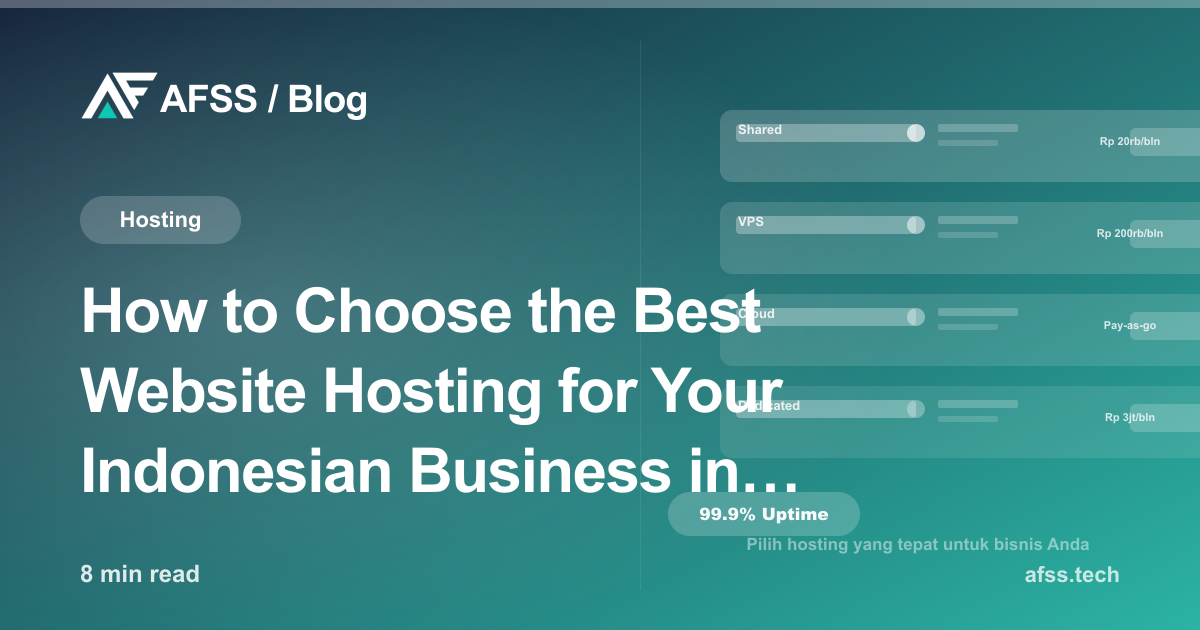
Your business website is ready to launch, the design looks great, the content is complete — but there's one important decision that determines whether it will run smoothly or become an endless headache: choosing the right hosting.
Hosting is the "home" where your website's files are stored and accessed by visitors. Bad hosting will make your website slow, prone to downtime when you need it most, or vulnerable to cyberattacks. This guide helps you choose the right hosting for your business needs and budget.
Why Hosting Matters So Much
Hosting is not a component you can afford to overlook. Some direct impacts of a poor hosting choice:
Website speed: A slow server directly affects page load times. Every extra second of loading can drop conversions by 7% and significantly increase bounce rates. Website speed is also a Google ranking factor.
Uptime: How long can your website be accessed in a given month? Poor hosting can cause downtime lasting hours or even days — costing you customers and revenue.
Security: Hosting with weak security makes your website vulnerable to hacking, customer data theft, or being used to spread malware.
SEO: Google prioritizes websites that are fast and consistently available. Slow or frequently down hosting directly hurts your SEO ranking.
Types of Website Hosting
1. Shared Hosting
A single physical server shared by many websites (potentially hundreds to thousands). Resources (CPU, RAM, bandwidth) are shared among all of them.
Advantages:
- Cheapest option: Rp 20,000–150,000/month
- Easy, fast setup
- Maintenance fully handled by the provider
Disadvantages:
- Unstable performance — if a neighboring website goes viral, your site's speed gets affected too (the "noisy neighbor effect")
- Limited resources — not suitable for high-traffic websites
- More vulnerable security due to a shared environment
Best for: Personal portfolio websites, small blogs, or SME websites with low, non-critical traffic.
2. VPS (Virtual Private Server) Hosting
A single physical server divided into several isolated "virtual machines." You get a dedicated resource allocation — unaffected by other users.
Advantages:
- Much more stable and predictable performance than shared hosting
- Greater control: root access, custom server configuration
- Resources can be scaled as needed
- More secure due to isolation from other users
Disadvantages:
- More expensive: Rp 200,000–1,000,000/month
- Requires technical knowledge to manage (or managed VPS at a higher cost)
Best for: Business websites with medium traffic, online stores, simple web applications.
3. Dedicated Server
A physical server used exclusively by you — shared with no one else.
Advantages:
- Highest performance and security
- Full control over the server
Disadvantages:
- Very high cost: Rp 3–20M/month
- Requires an IT team capable of managing the server independently
Best for: Enterprise websites with very high traffic, applications with strict security or regulatory requirements.
4. Cloud Hosting
Unlike shared/VPS hosting based on a single server, cloud hosting distributes your website across many servers. If one server has an issue, another takes over automatically.
Advantages:
- High scalability — capacity can scale up or down as needed
- High availability — minimal downtime
- Pay-as-you-go pricing
Disadvantages:
- Costs can be unpredictable if traffic suddenly spikes
- More complex setup
Best for: Web applications, e-commerce, or websites that need high scalability and availability.
5. Managed WordPress Hosting
Hosting optimized specifically for WordPress websites, with management, updates, backups, and security handled by the provider.
Advantages:
- No need to worry about WordPress, plugin, and security updates
- Performance optimized specifically for WordPress
- Support with deep WordPress expertise
Disadvantages:
- Higher price than regular shared hosting
- Locked into the WordPress ecosystem
Best for: Businesses using WordPress without an in-house IT team for maintenance.
6. Static Site Hosting (Jamstack)
For websites built with modern technology (Next.js, React, Vue, Astro) that generate static HTML files. Platforms like Vercel, Netlify, or Cloudflare Pages host and deploy these websites with high efficiency.
Advantages:
- Extremely fast (static files served from a global CDN)
- Very cheap or even free for moderate traffic
- High security (no server-side code that can be attacked)
- Auto-deploy from a git repository
Disadvantages:
- Not suitable for applications requiring complex dynamic server-side rendering
Best for: Company profile websites, landing pages, blogs, portfolios — especially those built with modern technology like what we use at AFSS.
Key Criteria for Choosing Hosting
1. Uptime Guarantee
What uptime guarantee is offered? 99% means up to 87 hours of downtime per year. 99.9% = 8.7 hours per year. 99.99% = 53 minutes per year. For a business, a minimum of 99.9% uptime is an absolute requirement.
Also ask: what compensation is offered if uptime isn't met? A strong SLA shows a provider's confidence.
2. Server Speed and Data Center Location
A server closer to your visitors is faster. For an Indonesian audience, choose a server located in Southeast Asia (Singapore is the most popular SEA hub) or Indonesia itself.
Ask for server specs: SSD or HDD? How much RAM and CPU is allocated?
3. Security
Minimum security features that must be present:
- Free SSL certificate (Let's Encrypt)
- Firewall and DDoS protection
- Automatic daily backups
- Malware scanning and removal
- Isolation between accounts (so one hacked account doesn't affect others)
4. Scalability
A growing business needs hosting that can grow with it. Make sure it's easy to upgrade your plan without needing to migrate to another provider.
5. Customer Support Quality
When your website goes down in the middle of the night or there's a critical issue, who can you reach? 24/7 support via live chat or phone is the standard you should demand for business hosting.
Test support responsiveness before subscribing — send a technical question and measure the speed and quality of their response.
6. Transparent Pricing
Be wary of very cheap first-year promotional pricing that jumps drastically at renewal. Always check the renewal price, not just the signup price.
Also watch out for paid add-ons that should already be included: backups, SSL, security, migration.
Popular Hosting Providers in Indonesia
Local (Indonesia Data Center)
Niagahoster, IDCloudHost, Jagoan Hosting, Rumahweb
- Advantages: Servers located in Indonesia (faster connections for local audiences), Indonesian-language support, familiar with local regulations
- Best for: Websites targeting the Indonesian market that need fast domestic connections
Regional (Southeast Asia)
Vultr, DigitalOcean, Linode (Akamai) with Singapore servers
- Advantages: Competitive pricing, excellent performance, full control
- Best for: VPS setups with a technical team able to manage the server
Global Enterprise
AWS, Google Cloud Platform, Microsoft Azure
- Advantages: Highest reliability, the most complete service ecosystem, global CDN
- Best for: Enterprise applications, high traffic, strict compliance needs
Modern Static Hosting
Vercel, Netlify, Cloudflare Pages
- Advantages: Extremely fast (global CDN), best developer experience, cheap/free for static websites
- Best for: Modern websites built with frameworks like React/Vue/Next.js (like what AFSS builds)
Our Recommended Hosting for Each Use Case
- Landing page / company profile: Vercel or Netlify — free, fast, auto-deploy from git
- WordPress blog: Niagahoster or IDCloudHost managed WordPress
- Online store (medium traffic): VPS from Vultr/DigitalOcean with a Singapore server, or cloud hosting
- Business web applications: Cloud hosting (AWS/GCP) or a managed dedicated VPS
- Enterprise: AWS or GCP with an architecture designed for high availability
Hosting Pitfalls to Avoid
"Unlimited" That Isn't Really Unlimited
Many providers advertise "unlimited bandwidth" and "unlimited storage" — but in the fine print, there's often a fair use policy that's actually quite restrictive. A website with reasonable traffic won't have issues, but as your business grows, you'll hit that limit.
No Reliable Backups
"Our hosting includes backups" isn't good enough. Ask: how often are backups taken? How long are they retained? How easy is it to restore them? Ideally, backups should be daily, retained for at least 7 days, and restorable by yourself without needing support assistance.
Being Tempted by Cheap Prices Without Considering Total Cost of Ownership
Rp 20,000/month hosting that makes your website frequently down and slow can cost you far more in lost business. Calculate the total cost including downtime risk and migration costs if you ever need to switch.
Forgetting the SSL Certificate
Since 2018, Google Chrome has displayed a "Not Secure" warning for websites without HTTPS. This instantly kills visitor trust. An SSL certificate is a must — and many providers already include it for free.
Hosting Selection Checklist
Before subscribing, make sure:
- Uptime guarantee of at least 99.9%
- Server located in Southeast Asia or Indonesia
- Free SSL certificate (Let's Encrypt)
- Automatic daily backups
- Responsive 24/7 support
- Renewal price not drastically different from the promo price
- Easy migration (downloadable site backups)
- Easy scalability as your business grows
Conclusion
The right hosting is the foundation of a reliable business website. Don't choose hosting based on price alone — consider uptime, speed, security, and support quality that will support your business.
If you build your website with us, AFSS will recommend and help set up the most suitable hosting for your website's specific needs — from ultra-fast static hosting to cloud infrastructure for complex applications. Get a free consultation to discuss your hosting needs.
Have a similar project?
Free consultation, no commitment. Tell us what you need — we'll help you find the best solution.
Free Consultation