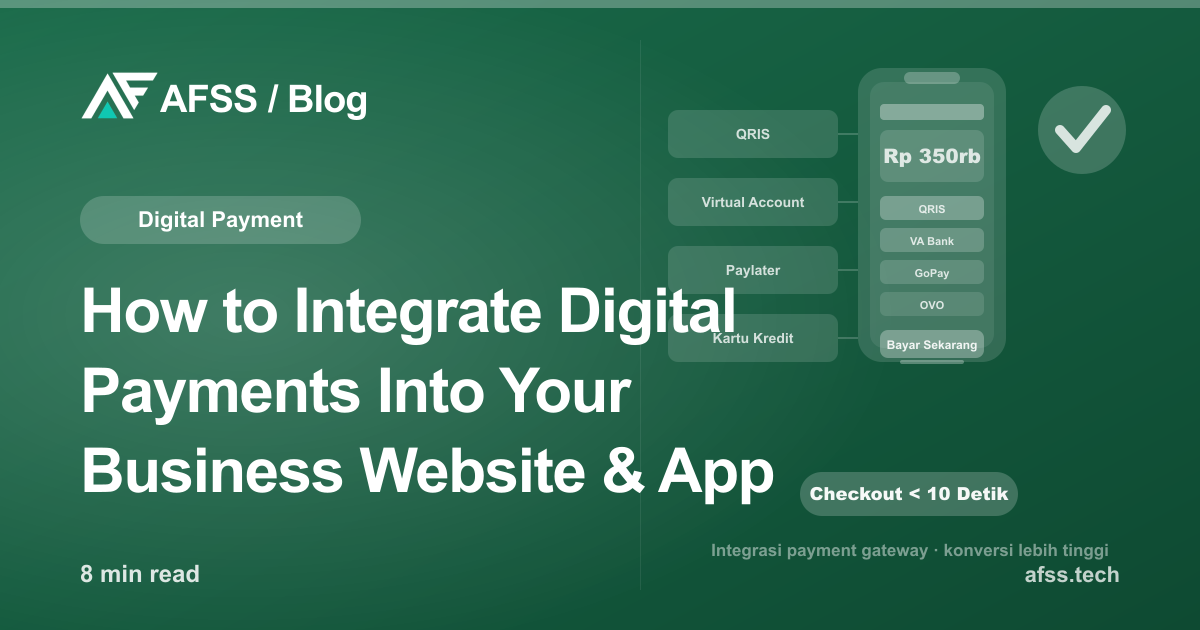
One of the most critical moments in a customer's journey is at payment. It doesn't matter how well-designed your website is or how attractive your offer looks — if checkout is complicated, slow, or doesn't offer the customer's preferred payment method, conversions will plummet. This is why proper digital payment integration isn't just an add-on feature, but a foundation of a digital business that actually generates revenue.
This article dives deep into how to choose the right payment gateway for a business in Indonesia, the technical aspects you need to understand, and practical strategies to maximize your checkout conversion rate.
Why Digital Payment Is a Must-Have in 2026
Bank Indonesia data shows that non-cash transactions keep growing significantly every year, with QRIS, bank transfers, and digital wallets already the preferred choice of Indonesian consumers across all ages. Businesses that still force customers into manual transfers and WhatsApp confirmations are not only losing operational time, but also losing customers who won't wait for payment confirmation.
Beyond that, modern buyers expect a checkout experience that's instant and secure. They want to be able to pay within seconds without repeatedly switching between apps. Businesses that meet this expectation will outperform competitors still stuck with manual processes.
Types of Popular Payment Gateways in Indonesia
Local Payment Aggregators
Payment aggregators like Midtrans, Xendit, and Duitku are the most common choice for businesses in Indonesia. Their main advantage is a single integration that directly supports dozens of payment methods — from bank transfers via BCA, BRI, BNI, Mandiri, to GoPay, OVO, Dana, ShopeePay, and QRIS.
Midtrans (owned by GoTo) has a very mature ecosystem and comprehensive documentation. Good for businesses that need high flexibility and already have an internal technical team.
Xendit is known for its clean API and good developer experience, plus strong business-to-business (disbursement) services. Good for tech startups that need fast integration.
Duitku offers competitive transaction fees and suits SMEs just starting to digitize their payment process.
Bank Payment Gateways
Some major Indonesian banks like BCA (BCA KlikPay / Virtual Account) and Mandiri offer direct integration. They usually have lower fees but a longer onboarding process and more complex technical integration. Good for businesses with high transaction volume that already have a business relationship with the relevant bank.
Direct Digital Wallets
GoPay, OVO, Dana, and ShopeePay each provide their own API. Integrating each digital wallet separately can take a long time — which is why payment aggregators are usually more efficient, since they've already combined everything into a single integration.
Payment Methods You Must Offer
Based on digital consumption patterns in Indonesia, here are the payment methods that should be available on your website or app:
- QRIS — one QR code for all digital wallets. A must-have because its penetration is already very wide and the process is very fast.
- Virtual Account (VA) — good for large-value transactions since customers can transfer from an ATM or mobile banking of any bank.
- GoPay & OVO — the two digital wallets with the most users in Indonesia.
- ShopeePay — dominant among users active in the Shopee ecosystem.
- Credit/Debit Cards — important for the premium segment and high-value purchases, especially if your target market includes corporate buyers.
- Paylater (Akulaku, Kredivo, GoPayLater, ShopeePayLater) — increasingly crucial for raising average order value, since customers can buy now and pay later in installments.
Technical Aspects of Payment Gateway Integration
REST API vs SDK
Almost all modern payment gateways provide two integration methods:
Direct REST API — more flexible, good for teams who want full control over the checkout display and flow. Requires server-side implementation for security.
SDK (Software Development Kit) — available for various languages (JavaScript, PHP, Python, Java, etc.). Speeds up integration since much of the logic is already implemented in the SDK. Good for teams that want fast integration.
For React/Next.js-based websites, Midtrans and Xendit provide JavaScript libraries that can be integrated relatively quickly. For Flutter or React Native mobile apps, SDKs supporting both platforms are available.
Transaction Security
Payment integration must follow these security standards:
- HTTPS/SSL for all communication — no exceptions.
- Server-side validation — never validate payment status from the client side alone (browser/app). Always confirm from the server using notifications/webhooks from the payment gateway.
- Signature verification — use the signature mechanism provided by the payment gateway to verify that a payment notification truly comes from them, not from someone trying to spoof a transaction status.
- Never store card data — store only the token provided by the payment gateway, not card numbers or CVV. This isn't just best practice, it's a requirement for PCI DSS compliance.
Webhooks and Real-Time Notifications
One of the most important components that's often overlooked is the webhook. The payment gateway sends real-time notifications to a URL you specify whenever a transaction's status changes — for example, from "awaiting payment" to "successful" or "expired."
Your server-side webhook handler is responsible for:
- Verifying the notification signature
- Updating the order status in the database
- Triggering the fulfillment process (product shipping, service activation, etc.)
- Sending confirmation to the customer
Without a properly functioning webhook, your system won't know a customer has paid unless the customer reports it manually — a very poor experience.
A Checkout Experience That Converts
Getting the technical side right isn't enough — a converting checkout also needs attention to UX:
Minimize Checkout Steps
Every extra step in the checkout process reduces the likelihood a customer completes the purchase. Ideally, checkout can be completed in 3 steps: fill in shipping details → choose payment method → confirm. For repeat purchases, save shipping details so customers don't need to re-enter them.
Display All Payment Options Clearly
Use the official logo for each payment method so customers instantly recognize the available options. Logical grouping (Digital Wallets / Bank Transfer / Cards / Paylater) helps customers find their preferred method faster.
Real-Time Feedback
After payment, provide clear instant confirmation — either through a success page or automated email/WhatsApp. Uncertainty after a bank transfer is one of the top sources of customer complaints.
Optimize for Mobile
More than 70% of digital transactions in Indonesia happen via smartphone. Make sure the checkout form is easy to fill in on a small screen, buttons are large enough to tap with a finger, and no elements overflow on mobile screens.
Transaction Fees: What You Need to Understand
Every payment gateway charges an MDR (Merchant Discount Rate) or a per-transaction fee. Rates vary:
- Bank Virtual Account: usually a flat Rp 4,000–5,500 per transaction
- Digital wallets (GoPay, OVO, etc.): 0.7%–2% of the transaction value
- QRIS: around 0.7% (Bank Indonesia's official rate for merchants)
- Credit cards: 2%–3% of the transaction value
For businesses with low volume but high transaction values (e.g., B2B services), the flat VA fee is more favorable. For businesses with high volume but small transaction values (FMCG retail), consider QRIS since its rate is the lowest.
Testing Before Going Live
Before activating your payment gateway for real transactions, run thorough testing in a sandbox/staging environment:
- Test every payment method you plan to offer
- Simulate successful, failed, and expired transactions
- Make sure webhooks work correctly
- Test edge cases: very large-value transactions, simultaneous transactions, and connection-drop scenarios mid-process
Bugs in the payment flow discovered after going live can cause real financial loss and hard-to-recover customer trust.
Integration With Other Systems
A payment gateway isn't a standalone system. For efficient business operations, integrate it with:
- Inventory system — automatically reduce stock after successful payment
- Accounting or ERP system — automatically record revenue without manual entry
- CRM — update customer data and transaction history
- Notification system — send confirmation via email, WhatsApp, or push notification
End-to-end integration like this eliminates the need for time-consuming, error-prone manual reconciliation. Also read: API Integration for Business Systems to understand more about connecting different systems.
Conclusion
Good digital payment integration is a combination of the right technology choice, secure implementation, and a seamless user experience. It's not just about "being able to pay," but about making customers willing to complete the payment without friction.
If you're building an online store website, a web app, or a mobile app that needs payment gateway integration, AFSS has experience integrating Midtrans, Xendit, and various other payment gateways into many types of platforms. Get a free consultation on your business's digital payment needs.
Have a similar project?
Free consultation, no commitment. Tell us what you need — we'll help you find the best solution.
Free Consultation