Custom Websites & Applications as the Foundation of Business Growth in the Digital Era
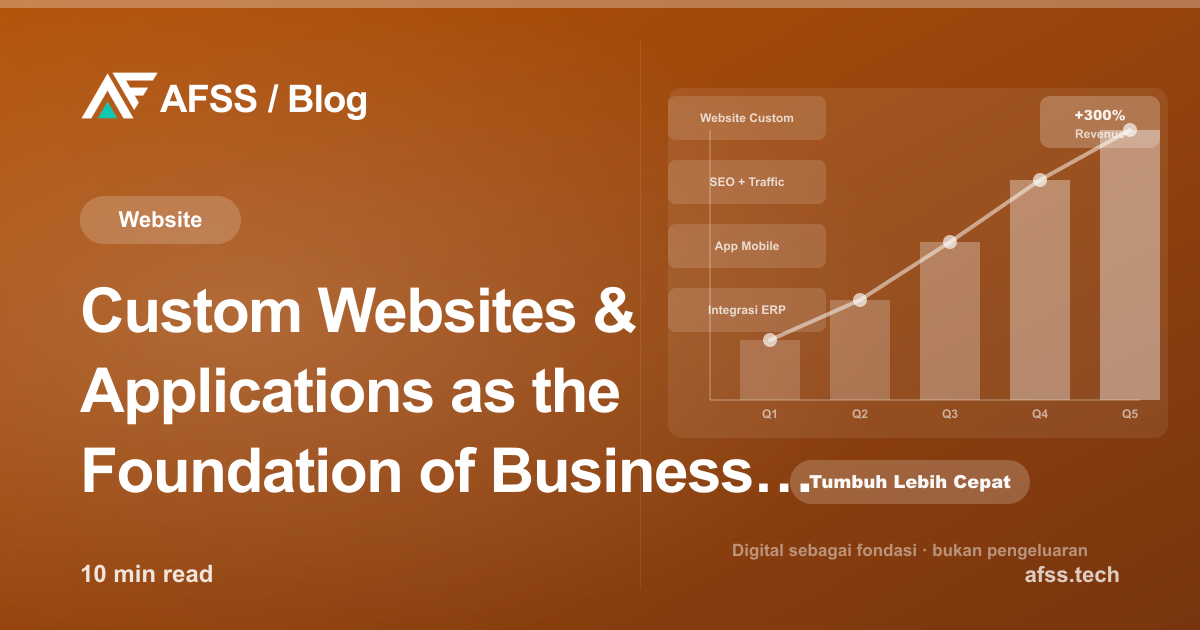
There are two very different ways of viewing business websites and applications. The first sees them as an IT expense — something every business needs to have, but should keep as cheap as possible. The second sees them as growth infrastructure — a foundation that determines how fast and how far a business can grow.
Businesses that succeed in growing significantly in the digital era almost always fall into the second camp. Not because they have huge technology budgets, but because they understand the leverage the right technology offers for business growth.
This article discusses why custom websites and applications form a foundation for growth that's different from simply "having a website," what makes the difference, and how to maximize a technology investment for long-term business growth.
The Difference Between "Having a Website" and "A Website as a Growth Asset"
Almost every business now has a website. But there's a big difference between a website that merely "exists" and one that actually generates results — bringing in new leads, converting visitors into buyers, building trust, and delivering an experience that keeps customers coming back.
A Website That Merely "Exists"
- A static appearance that hasn't been updated in months
- Doesn't appear on the first page of Google for relevant keywords
- Slow loading, so visitors leave before content even loads
- No way to track who's visiting and what they're doing
- Not integrated with other business processes (no CRM connection, no follow-up automation)
- A generic template that doesn't reflect the brand or the business's uniqueness
A Website as a Growth Asset
- Optimized for organic search (SEO) so it keeps bringing in traffic without ad spend
- Fast loading and a smooth user experience that boosts conversion
- Every visitor is tracked, so marketing strategy can be optimized based on real data
- Integrated with CRM, email marketing, and other business systems for an efficient flow
- Consistently reflects the brand and builds trust in a way a template can't replicate
Why Custom Beats Templates or Generic SaaS
Unlimited Flexibility
Templates or builder tools like Wix, Squarespace, or WordPress with a page builder do make building a website easier. But once your business needs specific features — integration with internal systems, a unique purchase flow, complex pricing calculations, or a look that truly matches your brand — templates start showing their limits.
A custom website is built exactly to your business's needs. There's no compromise of "this can't be done because the template doesn't support it." Every feature you need can be built, and it can work exactly the way your business operates.
Better Speed and Performance
Popular CMS-based websites like WordPress are often slower than custom websites due to the accumulated weight of plugins. Google has explicitly stated that website speed is an SEO ranking factor — faster websites rank higher in search results.
A custom website built on a modern stack (like React + SSG, which we use) typically scores much higher on Google Lighthouse — meaning it's faster, better for SEO, and offers a better user experience.
Full Ownership Without Vendor Lock-in
SaaS platforms like Shopify, Wix, or Webflow offer convenience, but you don't own the code or the infrastructure. If the platform raises prices, discontinues a feature, or shuts down, your business is directly affected.
With a custom website or application, the code is 100% yours. It can be hosted anywhere, developed by any team, and there's no dependency on a single vendor.
Better, More Flexible SEO
Technical SEO — URL structure, schema markup, sitemaps, meta tags, structured data, Core Web Vitals — can be implemented optimally on a custom website without the constraints that come with a generic platform. This isn't a small detail: proper technical SEO optimization can mean the difference between appearing on page 1 or page 10 of Google.
A Website as a Customer Acquisition Engine
Businesses that treat their website as an active growth asset invest in:
Content Marketing and Blogging
A blog with relevant, quality content is one of the most cost-effective customer acquisition strategies in the long run. Every article that answers a question your target customers are searching for is a "digital employee" working 24/7 to bring in organic traffic — with no cost per click.
Read more: How to Build a Website That Generates Business Results
Optimized Landing Pages
Every marketing campaign — Google ads, Meta ads, email marketing, influencer endorsements — should lead to a landing page designed specifically to convert, not to a generic homepage. A well-optimized landing page can boost conversion 2–5x compared to sending traffic to the homepage.
Conversion and Lead Capture
A good website doesn't just bring in traffic — it converts visitors into leads or buyers. This involves: persuasive copy, design that builds trust, clear CTAs (calls-to-action), easy-to-fill forms, and automated follow-up mechanisms.
Mobile Apps as a Loyalty Channel
If a website is your digital "storefront," a mobile app is the membership card that keeps your business in your customers' pockets at all times. Mobile apps offer advantages a website can't match:
Push Notifications — the ability to actively reach customers with relevant offers, updates, or reminders, right on their phone screen. Emails often go unopened; push notifications are far more effective for time-sensitive messages.
A Smoother Experience — a native or hybrid app optimized for mobile provides a more responsive experience, better integrated with phone features (camera, GPS, Face ID) than a mobile website.
Richer Usage Data — apps collect far more detailed user behavior data, enabling better personalization.
Offline Capability — certain features can function without an internet connection, important for use cases in the field.
See also: Mobile Apps for Business
Integration: The Real Value of a Digital Ecosystem
A website and app integrated with other business systems create a mutually reinforcing digital ecosystem:
- Leads from the website automatically flow into the CRM for the sales team to follow up
- Purchases on the website automatically deduct from inventory and enter financial reports
- User behavior data in the app is used for more precisely targeted email marketing segmentation
- Customer support systems are connected to transaction history for more personalized responses
Without integration, every system operates in a silo — requiring manual input, data reconciliation, and generating a lot of operational inefficiency.
Measuring ROI on Your Website and App Investment
A good technology investment needs to be measurable. Some metrics worth tracking:
Website:
- Organic traffic (visitors from Google search) — is it steadily growing?
- Conversion rate (% of visitors taking the desired action)
- Cost per acquisition (how much it costs to acquire one new customer through the website)
- Bounce rate (% of visitors who leave immediately) — an indicator of content relevance and UX
Mobile App:
- Daily/Monthly Active Users (DAU/MAU)
- Retention rate (% of users still active after 30/60/90 days)
- In-app conversion rate
- Session duration
If these numbers aren't tracked, it becomes very hard to optimize and prove the value of the technology investment. Read also: How to Measure ROI on Your Business Technology Investment
When to Upgrade from Template/SaaS to Custom
A question we often get: "When is the right time to upgrade from a template website to a custom website?" The answer is when:
- The platform's limitations start blocking your ideas or business needs
- The monthly SaaS cost starts to feel expensive relative to the value you're getting
- Integration needs with other systems can't be met by the existing platform
- The business is stable enough to make a long-term technology decision
- The website has become a significant customer acquisition channel that needs further optimization
For a startup at its earliest stage, starting with a template or SaaS can make sense for rapid validation. But once traction is proven, investing in a custom solution is a move that almost always pays off in the medium term.
A Realistic, Phased Strategy
Not every business needs to build a complete digital ecosystem right away. A sensible phased approach:
Phase 1: A professional website that's SEO-ready, fast, and converts — this is the foundation. Without this, all digital marketing investment will be less efficient.
Phase 2: Integration with CRM and email marketing to capture and systematically follow up on leads.
Phase 3: A mobile app (if your product/service requires regular interaction from customers) and deeper integration with operational systems.
Phase 4: A more comprehensive ERP or business system to automate operations and support larger-scale growth.
Each phase builds on the foundation already in place — you don't have to start from zero each time.
Conclusion
Websites and applications built with the right purpose and quality aren't just about "having a digital presence" — they're business assets that keep working for your growth 24/7/365. The difference between businesses that grow rapidly and those that stagnate in the digital era can often be traced back to the quality and strategy of their technology investment.
AFSS is here to help Indonesian businesses build a strong digital foundation — from a website optimized for growth to mobile apps and ERP systems that support operations at a larger scale. Every solution we build meets a high quality standard, with code that fully belongs to the client, and a focus on real business outcomes. Discuss your business's digital foundation with us — free consultation.
Have a similar project?
Free consultation, no commitment. Tell us what you need — we'll help you find the best solution.
Free Consultation