Choosing an ERP (Enterprise Resource Planning) system is one of the most important technology decisions a company's management will make. And in 2026, the question that comes up most often is: cloud ERP or on-premise?
Both approaches come with different trade-offs, and the "right" answer depends on your business size, industry, budget, and security priorities. This article covers it all in depth.
What's the Fundamental Difference Between Cloud and On-Premise ERP?
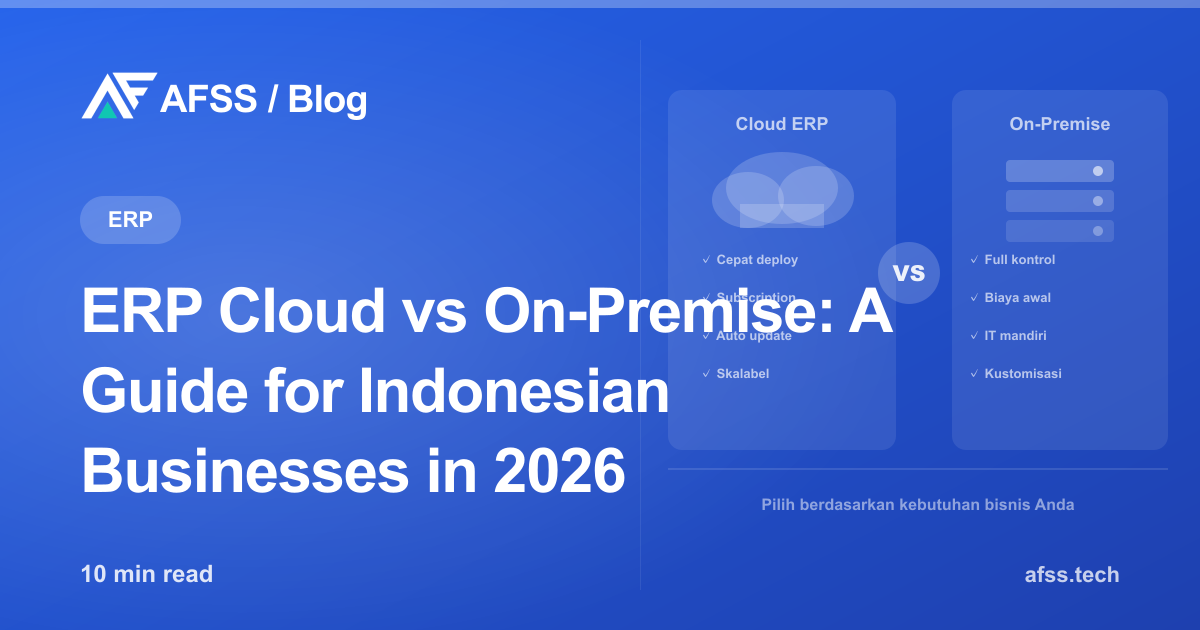
On-Premise ERP means the ERP software is installed and run on your company's own physical servers — whether at your office or in a data center you rent. You have full control over data, infrastructure, and customization.
Cloud ERP (SaaS/Hosted) means the ERP system runs on a vendor's or cloud provider's servers (AWS, Azure, Google Cloud). You access it via browser or app, pay a subscription, and the vendor is responsible for maintenance, updates, and infrastructure security.
There's also a third, increasingly popular model: Hybrid ERP — a combination of both, where sensitive modules (finance, HR) stay on-premise while other modules (CRM, field service) run in the cloud.
Cost Comparison: Total Cost of Ownership (TCO)
This is an area where many businesses make the wrong call because they only look at upfront cost, not the total cost over 5 years.
On-Premise ERP — 5-Year Cost
Upfront cost (year 1):
- Software license: Rp 150M–800M (depending on modules and number of users)
- Server hardware: Rp 50M–200M
- Implementation & customization: Rp 100M–500M
- Training: Rp 20M–50M
- Total year 1: Rp 320M – 1.5B
Ongoing costs (years 2–5):
- Annual maintenance & support: 15–20% of license cost
- IT staff (salary, benefits): Rp 60M–180M/year
- Hardware refresh (every 3–5 years): Rp 50M–150M
- Major software upgrades: Rp 50M–200M per event
5-year total (mid-range estimate): Rp 900M – 3B
Cloud ERP — 5-Year Cost
Upfront cost (year 1):
- Setup & onboarding: Rp 20M–100M
- Customization: Rp 30M–150M (more limited than on-premise)
- Training: Rp 10M–30M
- Total year 1: Rp 60M–280M
Ongoing costs:
- Monthly subscription: Rp 5M–50M/month depending on modules & users
- Minimal IT staff (mostly managed by the vendor)
5-year total (mid-range estimate): Rp 500M – 1.5B
Cost conclusion: Cloud is generally cheaper over the first 5 years, especially for mid-sized businesses. On-premise can be more economical long-term (8–10 years) if you have a solid internal IT team.
Data Security: Which Is Safer?
This is the number-one concern for Indonesian businesses, especially in finance, healthcare, and manufacturing.
On-Premise: Full Control, Full Responsibility
With on-premise, data never leaves your infrastructure. For industries bound by strict regulations (banking, insurance, government), this can be a non-negotiable requirement.
On-premise security advantages:
- Data stays entirely under your control
- No data crosses third-party internet infrastructure
- Audit trail is entirely internal
- Not dependent on a vendor's SLA
On-premise risks:
- Security is entirely your internal IT team's responsibility
- Backup and disaster recovery must be managed in-house
- Security patches must be applied manually — and are often late
- A single point of failure if the server has issues
Cloud: Enterprise-Grade Security by Professionals
Major cloud ERP vendors (SAP, Oracle, Microsoft Dynamics, Odoo Cloud) invest hundreds of millions of dollars a year in security. They have 24/7 security teams, SOCs (Security Operations Centers), and international certifications (ISO 27001, SOC 2, etc.).
Cloud security advantages:
- Security patches are applied automatically and quickly
- Automatic backups across multiple geographic regions
- Data encryption in-transit and at-rest
- Enterprise-grade DDoS protection
- Already-certified compliance frameworks
Cloud risks:
- Data resides on vendor servers (albeit encrypted)
- Vendor downtime can affect your operations
- Potential data residency issues (where the physical data is stored)
- Internet connectivity is a single operational point of failure
Context for Indonesia in 2026: OJK and various sector-specific regulations have data residency requirements. Make sure your cloud ERP vendor has a data center in Indonesia or meets the regulatory requirements applicable to your industry.
Scalability & Flexibility
Cloud clearly wins here. Adding 50 new users to a cloud ERP is usually as simple as changing your subscription plan. With on-premise, that might mean buying new licenses, upgrading hardware, and involving IT.
For businesses growing quickly or with fluctuating needs (high seasonality), cloud offers flexibility that on-premise can't match.
On-premise is more flexible for deep technical customization. You can modify source code, build custom integrations, or tweak workflows for highly specific business needs. Cloud ERP usually has stricter customization limits.
Implementation & Time-to-Value
Cloud is faster to implement. Mature cloud solutions (Odoo, SAP Business Cloud, Sage Intacct) can go live in 2–6 months for a mid-sized business.
On-premise usually takes 6–18 months for full implementation, depending on customization complexity and the number of modules.
For businesses that need a quick win and fast ROI, cloud clearly has the edge.
When Should You Choose On-Premise?
Choose on-premise if:
- Your industry is bound by strict regulations that prohibit or restrict third-party data storage
- You have a competent IT team willing to take on maintenance responsibility
- Your customization needs are very deep and specific to unique business processes
- You're a large enterprise with very high transaction volumes
- Internet connectivity at your operational locations isn't reliable
When Should You Choose Cloud?
Choose cloud if:
- You want fast implementation and to start using it within months
- Your internal IT team is limited or nonexistent
- Your business is growing and needs may change
- Your upfront budget is limited but you have cash flow for monthly subscriptions
- Users are spread across many locations (branches, WFH, field teams)
Custom ERP vs Off-the-Shelf ERP Software
Beyond the cloud vs on-premise decision, there's another choice to make: using existing ERP software (Odoo, SAP, Oracle, Microsoft Dynamics) or building a custom ERP system.
Off-the-shelf ERP software:
- Faster implementation
- More predictable costs
- Large community and vendor support
- Limited to the existing framework
Custom ERP:
- Built 100% around your unique business processes
- No unneeded features (leaner, faster)
- Higher upfront cost, but no perpetual subscription
- Full flexibility to evolve as needed
At AFSS, we have experience developing custom ERP systems for manufacturing, distribution, and service businesses across Indonesia — from finance, HR, inventory, and CRM modules to procurement. All integrated into a single platform that matches the client's exact workflow.
Checklist Before You Decide
Before choosing, answer these questions:
- How many ERP users do you need? (< 50 users tends to fit cloud better)
- Are there regulatory requirements around data residency?
- How strong is internet connectivity at all your operational locations?
- Do you have a competent internal IT team?
- How unique are your business processes compared to your industry in general?
- What's your upfront budget vs. your monthly cash flow capacity?
- How quickly do you need this system up and running?
Conclusion
There's no universal answer. For most Indonesian SMEs and mid-sized businesses, cloud ERP is the more pragmatic choice: faster to implement, easier to maintain, and more flexible for growth.
For enterprises with highly unique business processes or strict regulatory ties, on-premise or hybrid can be the more suitable choice, even at a higher cost.
What matters most is choosing based on your business's real needs — not chasing trends or vendor marketing hype. Consult with professionals who have no vested interest in selling you a particular product.
Contact us to discuss your business's ERP needs. We help you evaluate your options and design a solution — with no bias toward any particular product.
Have a similar project?
Free consultation, no commitment. Tell us what you need — we'll help you find the best solution.
Free Consultation