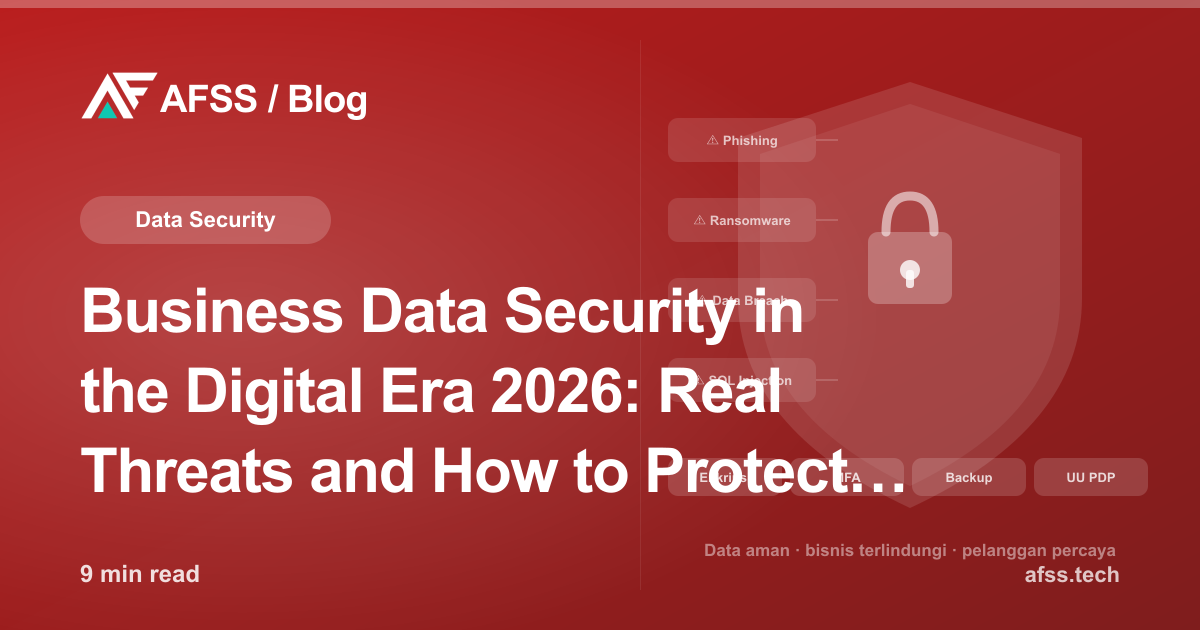
Business Data Security in the Digital Era 2026: Real Threats and How to Protect Against Them
Data is the most valuable asset of a modern business — and also the most tempting target for cybercriminals. In Indonesia, data breach cases are becoming increasingly common, and the victims aren't just large corporations. SMEs, startups, and mid-sized businesses are targeted too, often because they're assumed to have weaker defenses.
Understanding data security is no longer the exclusive domain of large corporate IT teams. In 2026, every business owner running digital operations needs at least a basic understanding of what needs protecting, from what threats, and how — even without an internal IT team.
Why Data Security Is Becoming More Critical in 2026
Several factors are making data security increasingly important:
Attacks are becoming more automated and cheaper. Tools for launching cyberattacks are increasingly accessible and now often AI-powered, meaning attackers with limited technical skill can carry out attacks that once required high expertise.
Businesses' digital data footprint keeps growing. More and more businesses store customer data, financial data, and operational data digitally — on servers, in the cloud, or in SaaS apps. The more data there is, the bigger the impact of a breach.
Regulation is getting stricter. Indonesia's Personal Data Protection Law (UU PDP) requires businesses to protect the personal data they manage. Failure to comply can result in significant administrative penalties, not to mention reputational damage that's far more costly.
Customer trust is a competitive asset. Businesses proven to be secure and responsible with customer data have a real competitive advantage — especially in an era when customers are increasingly aware of their privacy.
Types of Threats to Watch For
Phishing and Social Engineering
Phishing is the most common and most successful attack method. Attackers send emails, WhatsApp messages, or SMS that appear legitimate to trick employees into handing over login credentials or clicking malicious links. In the AI era, phishing messages are increasingly hard to distinguish from genuine communication, since they can be written in flawless language and personalized using information gathered from social media.
Social engineering attacks aren't always digital — they can also happen over the phone (vishing), where attackers pose as technical support, a vendor, or a regulator to gain access to sensitive information.
Ransomware
Ransomware is malware that encrypts business data and demands a ransom for the decryption key. These attacks can cripple business operations for days or weeks, with losses far exceeding the ransom demanded — including lost productivity, reputational damage, and system recovery costs.
Ransomware attacks often start with a single phishing email that successfully tricks one employee, then spread across the entire network.
Breaches Through Third-Party Applications
Modern businesses use dozens of SaaS applications — accounting, CRM, project management, HR, and more. Every application with access to your business data is a potential risk point. If one of your vendors suffers a breach, your data stored on their platform can be affected too.
Attacks on Websites and Applications
A website that isn't kept up to date or has coding vulnerabilities can become an entry point for attackers to:
- Steal customer data stored in the database
- Inject malware that then infects visitors
- Take over server control for further attacks
- Abuse server resources for cryptocurrency mining
Internal Threats
Not every data breach comes from an outside attacker. Disgruntled employees, careless handling of data, or former employees who still have active access are often-overlooked but significant sources of breaches.
What Needs to Be Protected
Before discussing protection methods, it's important to identify the most critical digital assets:
Customer data — names, addresses, phone numbers, emails, transaction history. This is the most sensitive data from both a regulatory and customer-trust perspective.
Financial data — bank accounts, transaction records, internal financial reports. A breach here can directly result in financial loss.
System credentials — usernames and passwords for every system in use. If these leak, every other system can be compromised.
Intellectual property — software source code, product formulas, business strategy, customer databases developed over years. This is a competitive asset whose value is often underestimated.
Operational data — contracts, proposals, internal communications. A breach here can jeopardize business negotiating positions.
Practical Steps to Protect Business Data
1. Use a Password Manager and MFA
Weak or reused passwords across many accounts are the most preventable cause of breaches. Use a password manager (such as Bitwarden, 1Password, or Dashlane) for all business accounts — generating long, unique passwords for every service.
Enable Multi-Factor Authentication (MFA) on every important system — email, cloud accounts, accounting systems, CRM. MFA ensures that even if a password leaks, an attacker still can't get in without a second factor (usually a code from an authenticator app or SMS).
2. Segment Access Rights
Not every employee needs access to all data. Apply the principle of least privilege — everyone gets access only to the data and systems truly needed for their job. This limits the impact if one account is compromised.
Audit access regularly, especially when employees leave. Deactivating a former employee's account on their last day is a mandatory procedure that's often missed.
3. Encrypt Data
Sensitive data must be encrypted both in transit (using HTTPS/TLS) and at rest (using database encryption). This ensures that even if data is successfully stolen, an attacker can't read it without the encryption key.
For businesses storing credit card data, compliance with PCI DSS is mandatory — never store full card numbers, only the token provided by the payment gateway.
4. Regular, Verified Backups
Backups are the last line of defense against ransomware attacks. Apply the 3-2-1 strategy: 3 copies of data, on 2 different media, with 1 copy off-site (for example, in cloud storage separate from your primary system).
Equally important: regularly test restoring your backups. Backups that are never tested often fail exactly when they're needed most.
5. Update Systems Regularly
Software and OS updates aren't just about new features — they often contain security patches that close known vulnerabilities. An unpatched system is an easy target for automated attackers constantly scanning the internet for vulnerable targets.
For websites, this means regularly updating your CMS (WordPress, etc.), plugins, and themes. For custom applications, the development team needs to regularly update the library dependencies in use. Read also: The Importance of Website Maintenance.
6. Security Training for Your Team
Even the most advanced technology can be defeated by one careless click from an employee. Make sure your whole team understands how to recognize phishing, the importance of not reusing passwords between personal and work accounts, and what procedure to follow if they receive a suspicious message or request.
Regular phishing simulations (without prior notice to employees) are an effective way to measure your team's readiness and identify areas that need improvement.
7. Choose Vendors That Take Security Seriously
Every SaaS service you use should be evaluated on its security. Questions to answer before adopting a new service:
- Do they offer MFA?
- How do they encrypt data?
- Have they had any past data breaches, and how did they respond?
- What is their data retention policy?
- Where is your data physically stored?
For custom-built solutions (websites, applications, ERP), make sure your development partner has clear security practices — from secure coding practices to code review procedures.
Compliance with Indonesia's PDP Law
The Personal Data Protection Law (Law No. 27 of 2022) requires every organization that processes personal data to:
- Have a valid legal basis for processing data (consent, contract, legitimate interest, etc.)
- Provide transparent notification to data subjects about how their data is used
- Ensure data subject rights are fulfilled — including the right to access, correct, and delete their data
- Report data breaches to authorities and affected data subjects within a certain timeframe
- Implement adequate technical and organizational measures to protect data
Businesses that don't yet have a clear privacy policy, explicit consent forms, and a mechanism for handling customer data requests need to address this promptly.
Building an Incident Response Plan
No system is 100% secure. The question isn't whether an incident will happen, but when and how prepared you are to face it. A good incident response plan covers:
- Who is responsible for coordinating the response
- How to isolate a compromised system so the damage doesn't spread
- Who needs to be notified (internal team, customers, regulators)
- How to document the incident for future analysis and improvement
- When and how to communicate publicly, if needed
This plan needs to be tested and updated regularly — not just created and forgotten.
Conclusion
Business data security in the digital era isn't optional — it's an operational and legal necessity. The good news is that most security incidents affecting small-to-medium businesses can actually be prevented with relatively simple but consistent steps.
AFSS builds every website, application, and system we develop with security standards integrated from the start — not as an afterthought. From data encryption to MFA implementation and secure API design, security is part of the foundation of every solution we build. Get a free consultation about your business's digital system security.
Have a similar project?
Free consultation, no commitment. Tell us what you need — we'll help you find the best solution.
Free Consultation