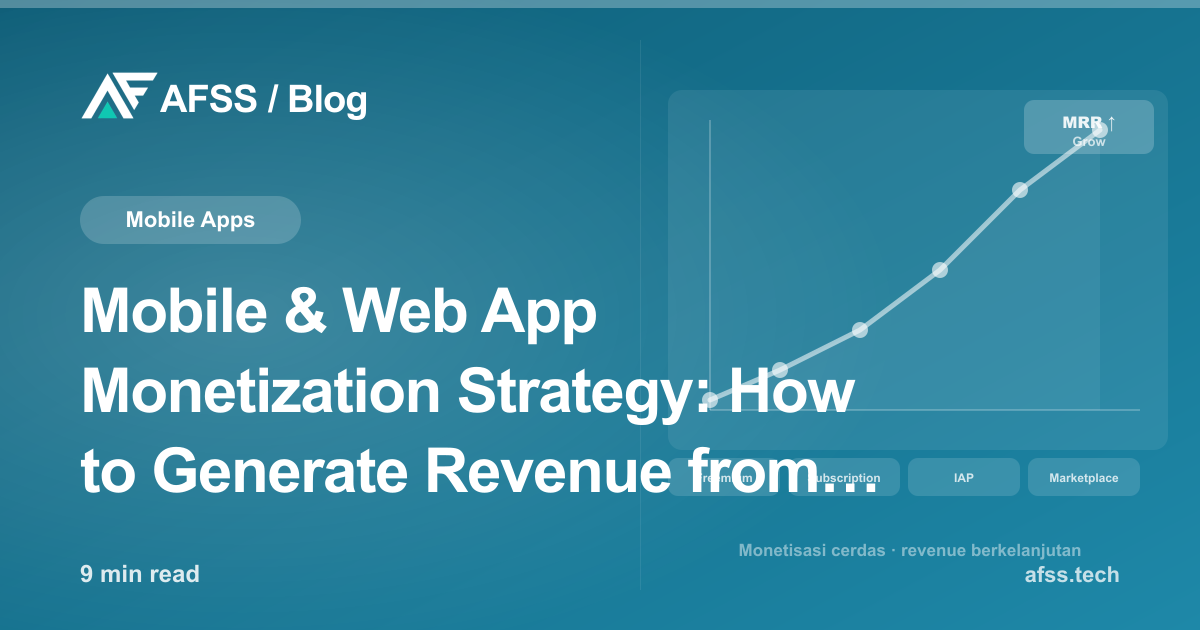
Mobile & Web App Monetization Strategy: How to Generate Revenue from Your App
Building a great app is one thing. Generating sustainable revenue from that app is a different challenge — and a crucial one for long-term success.
By 2026, app monetization models have become more diverse and sophisticated. Many apps use a combination of several models at once. This article covers proven monetization strategies, when to use them, and how to choose the best fit for your app and users.
Why Monetization Strategy Should Be Planned from the Start
A common mistake: building the app first, then thinking about monetization later. This is risky because:
- Architecture affects the monetization model: A subscription system needs authentication, billing cycles, and access management integrated from the beginning
- UX affects conversion: Paywall placement, pricing tiers, and upgrade flows designed from the start are far more effective than ones "bolted on later"
- Data analytics needs to be built in: You need proper tracking to understand where users convert (or fail to convert)
Model 1: Freemium
How it works: The app is free to download and use, but premium features are available for a fee.
Freemium is the most widely used model today. Spotify (free with ads, premium ad-free), Canva (free with limited templates, Pro with the full library), Notion (free for individuals, paid for teams).
When Freemium Works
- The app has clear value even in its free version — users can feel it before needing to upgrade
- There are premium features people genuinely want — not just basic features that have been locked away
- Regular, high-frequency usage — high engagement increases the likelihood of upgrading
- Viral/referral potential — free users can bring in new users
Freemium Challenges
- Low conversion rate: The industry average is only 2–5% of free users upgrading to paid. You need a lot of free users to generate significant revenue.
- Infrastructure cost for free users: Servers, bandwidth, and support for non-paying users need to be funded by paying users.
- "Free is expected": Once users get used to free, it's hard to change that expectation.
Implementation Tips
- Make sure the free version is good enough to drive viral growth, but not so good that there's no reason to upgrade
- Use usage limits (rather than feature locks) — let users try all features, but with volume caps (10 projects, 5 GB storage, etc.)
- Communicate premium value clearly — every time a user hits a limit, show them what they'd get by upgrading
Model 2: Subscription
How it works: Users pay a recurring fee (monthly or annually) for full access to the app.
SaaS (Software as a Service) almost always uses this model. It's the favorite model for B2B — predictable revenue and long-term customer relationships.
Advantages of Subscription
- Predictable revenue: Stable MRR (Monthly Recurring Revenue) makes business planning easier
- Aligned incentives: You stay motivated to keep delivering value so customers don't churn
- High lifetime value: A customer who stays 2–3 years is far more valuable than a one-time purchase
Subscription Challenges
- Harder acquisition: Users are more reluctant to commit to a subscription compared to a one-time purchase
- Churn must be actively managed: Customers who don't feel the value will cancel — managing retention is a full-time job
- Slow initial cash flow: The subscription model takes time to build up to significant revenue
Implementation Tips
- Offer a free trial (7, 14, or 30 days) — this is the most effective way to convert to subscription
- Discount for annual billing — ask for a longer commitment at a lower price. This also improves retention because users feel "invested"
- Clear tiers: Basic, Professional, Enterprise — each tier should have a clear target user
- Focus on onboarding: 90% of churn decisions are determined within the first 30 days of use
Model 3: In-App Purchase (IAP)
How it works: A free or paid app with additional purchases inside the app for specific items or features.
Very common in mobile apps, especially games. Also used in content marketplaces (photo filters, stickers, themes), productivity apps (premium templates), and creation platforms.
Types of IAP
- Consumable: Items that get used up — coins, credits, lives in a game. Users need to buy more.
- Non-consumable: Permanent items — unlocking features, removing ads, additional characters.
- Subscription: Recurring access (this actually overlaps with the subscription model above).
When IAP Works Well
- Game apps or ones with "progression" — users want to advance faster
- Creation apps with a constantly growing content library
- Platforms that already have an engaged user base willing to pay for customization
IAP Challenges
- Strict regulations: Apple and Google take 15–30% of every IAP transaction
- Balancing game design: IAP that's too "pay-to-win" damages engagement and reputation
- App Store review process: IAP changes have to go through a review that can take time
Model 4: Advertising
How it works: The app is free for users, and revenue comes from displaying ads to them.
This model lets an app be genuinely free — but there's a price paid in user experience.
When Ads Make Sense
- Very high user volume: Revenue per user from ads is very low (CPM $0.5–5 for mobile). You need millions of active users for significant revenue.
- Content-driven apps: News, entertainment, social media — content that's consumed continuously
- Users unwilling to pay: For price-sensitive user segments, ads might be the only feasible model
Advertising Challenges
- UX degradation: Excessive ads frustrate users and lead to uninstalls
- Unpredictable revenue: CPM and fill rate fluctuate with the ad market
- Privacy concerns: Ads that are too targeted can spark privacy controversies
- Competes with paid models: Users who can remove ads by subscribing is often a good justification for freemium
Successful Ad Formats
- Banner: Non-interruptive but very low click rate
- Interstitial: Full-screen between content — higher revenue but annoying if shown too often
- Rewarded video: Users voluntarily watch an ad to get a reward — highest engagement, best user experience for ads
Model 5: Pay-Per-Use / Usage-Based Pricing
How it works: Users pay based on how much they use the service — per transaction, per API call, per document processed, etc.
Popular in SaaS infrastructure (AWS, Twilio, Stripe) and increasingly used in business applications.
Advantages
- Low barrier to entry: No need to pay a lot upfront — start small and pay based on usage
- Natural scaling: Your revenue grows as your customer's business grows
- Users only pay for value received: More fair and easier to justify
Challenges
- Unpredictable revenue: Hard to plan cash flow
- Billing complexity: Requires an accurate metering and billing system
- "Bill shock": If users don't monitor their usage, a large bill can surprise them and drive them away
Model 6: Marketplace & Commission
How it works: The app connects buyers and sellers, and takes a commission from every transaction.
Gojek, Tokopedia, Airbnb — all built on this model. But the marketplace model can also apply to B2B apps that connect businesses with vendors or freelancers.
When This Model Works
- You can create a network effect: The more buyers, the more attractive it is for sellers, and vice versa
- There's a trust problem in the market that you can solve — buyers don't trust vendors directly, but they trust a reputable platform
- Large scale: A commission of 5–30% per transaction means you need significant volume for meaningful revenue
Hybrid Models: A Proven Combination
Many successful apps combine several models:
Freemium + Subscription + IAP: Free for new users, subscription for full access, IAP for specific items (like Clash of Clans)
Subscription + Usage-based: A base monthly fee + additional charges for usage above a threshold (like Twilio)
B2C Freemium + B2B Enterprise: Free for individuals, paid for teams/enterprise with SLAs and enterprise features (like Notion, Slack, Figma)
How to Choose the Right Model
Ask yourself:
- Who is your target user? B2C is more price-sensitive; B2B is more willing to pay but needs ROI justification.
- How often is the app used? Daily use → subscription makes more sense. Sporadic use → pay-per-use or one-time purchase.
- What's your CAC (Customer Acquisition Cost)? If it's expensive to acquire users, you need a high LTV → subscription or enterprise model.
- Are there network effects? If value increases with more users → freemium to grow the network.
- How complex is onboarding? Products that need lengthy setup → a free trial is more effective than freemium.
Metrics You Should Track
Whatever model you choose, track these metrics:
- MRR (Monthly Recurring Revenue): Total recurring revenue per month
- Churn Rate: Percentage of customers who cancel per month (target: < 2%)
- LTV (Lifetime Value): Average revenue per customer over their active lifetime
- CAC (Customer Acquisition Cost): Cost to acquire one customer
- LTV:CAC ratio: Should be > 3 for a sustainable model
- Conversion Rate: Percentage of free users who upgrade to paid
- ARPU (Average Revenue Per User): Average revenue per active user
Conclusion
There's no universally "best" monetization model. The best one is the one that fits your users, provides value proportional to the price, and is sustainable as a business.
Start by understanding your users more deeply: how much they're willing to pay, what value they get, and their usage patterns. From there, choose the model that aligns best.
AFSS helps design and build the right monetization system for your app — from subscription billing implementation and in-app purchases to accurate usage tracking systems. Get a free consultation to discuss your app's monetization strategy.
Have a similar project?
Free consultation, no commitment. Tell us what you need — we'll help you find the best solution.
Free Consultation