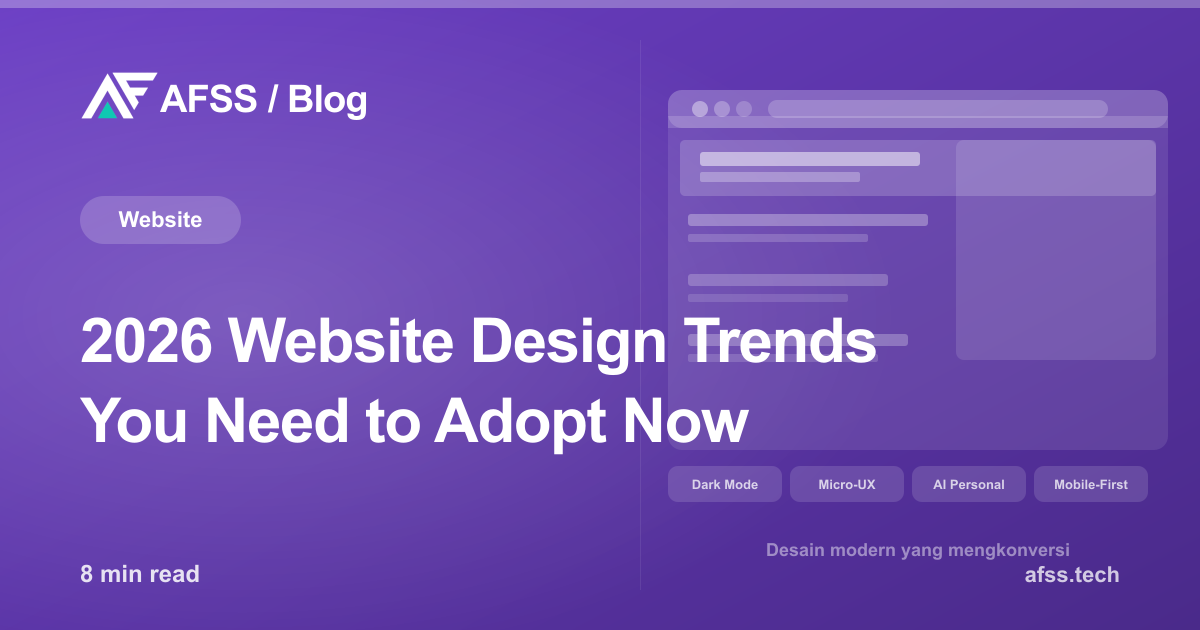
The world of website design is changing faster than ever. In 2026, Indonesian internet users have become increasingly sophisticated — they compare your website experience against global standards. If your business website still has a 2022 look and feel, the risk of losing customers is very real.
This article covers the most influential website design trends of 2026, along with why each one matters and how to apply it to your business.
1. Adaptive Dark Mode & System Preferences
More than 65% of smartphone users in Indonesia have dark mode enabled on their devices. In 2026, a website that only supports light mode already feels behind the times.
Proper adaptive dark mode isn't just about adding a theme-toggle button. It's about designing both modes from the ground up, making sure:
- Color contrast still meets WCAG 2.2 accessibility standards
- Images and illustrations look good in both modes
- CSS uses
prefers-color-schemeto automatically follow system preferences
Websites that implement dark mode properly see an average 18–24% increase in dwell time because visitors are comfortable staying longer to read content.
2. Meaningful Micro-Interactions
Micro-interactions are small animations that provide visual feedback — a button that "responds" when clicked, an informative loading state, or a smooth page transition. In 2026, users don't just appreciate these — they expect them.
Examples of effective micro-interactions:
- CTA buttons that move subtly on hover (not just a color change)
- Form inputs that give visual confirmation when filled in correctly
- Scroll-triggered animations that reveal content gradually (not all at once)
- Page transitions that flow smoothly between pages
The key is micro-interactions that are meaningful, not merely decorative. Every animation should have a purpose — guiding attention, giving feedback, or easing user anxiety while waiting.
At AFSS, we use Framer Motion to implement micro-interactions that feel natural rather than excessive.
3. Bolder, More Expressive Typography
The 2026 typography trend is moving toward variable fonts and bold editorial typography. Large text, high contrast, and clear hierarchy are hallmarks of modern websites.
Why this matters for conversion:
- A strong, readable headline captures attention within the first 3 seconds
- Variable fonts reduce font file size (one file = every weight)
- Good typographic hierarchy guides the user's eye toward the CTA
Popular 2026 font pairings: an expressive serif (for headlines) combined with a modern sans-serif (for body text) — exactly what we've applied on the AFSS website itself.
4. Minimalist Design with Aggressive Whitespace
In contrast to the "information-dense" trend of previous eras, 2026 celebrates empty space as an active design element. Whitespace isn't waste — it's a focus tool.
Websites with sufficient whitespace:
- Improve readability by up to 20%
- Make key elements (pricing, CTAs, benefits) easier to spot
- Feel more premium and trustworthy to users
For B2B and professional businesses, minimalist design with generous whitespace significantly boosts perceived credibility. Enterprise clients don't trust websites that feel "cluttered."
5. AI-Based Personalization
In 2026, the best websites no longer show the same content to everyone. AI enables real-time personalization based on:
- Visitor location (different content for Jakarta vs. Medan vs. Surabaya)
- Traffic source (visitors from Google vs. Instagram vs. referrals)
- Past behavior (pages previously visited)
- Time of visit (morning vs. night, weekday vs. weekend)
A simple implementation: dynamic greetings ("Good morning, reader from Medan!"), CTAs that change based on the referring page, or service recommendations based on visit history.
For SMEs and mid-sized businesses, basic geolocation-based personalization already delivers a real impact — without the cost of heavy AI infrastructure.
6. Mobile-First, Not Just Mobile-Friendly
There's a big difference between a website that's "mobile-friendly" and one designed mobile-first. In 2026, 78% of Indonesian business website traffic comes from mobile devices. Mobile isn't an afterthought — it's the primary experience.
Mobile-first design means:
- Layouts start at a 375px screen, then expand to desktop
- Minimum touch targets of 48x48px for all interactive elements
- Navigation that can be operated with one hand
- Properly lazy-loaded images for mobile connections
- Core Web Vitals optimized for mid-range devices
Websites that fail Google's Core Web Vitals on mobile lose significant SEO ranking. This isn't optional — it's mandatory.
7. Visual Storytelling with Data
Beautiful charts and data visualizations have become a hallmark of modern business websites. Instead of writing "we've helped 100+ clients," show that data in a visually compelling way.
The 2026 trend: illustrated data viz — infographics that feel custom and on-brand, not generic spreadsheet charts. Use scroll-based animation to reveal statistics gradually — this dramatically boosts engagement.
8. Accessibility as a Standard, Not an Add-On
WCAG 2.2 is no longer "nice to have" — it's the minimum standard expected by Google, users with disabilities, and serious businesses. In 2026, poor accessibility means:
- Losing 15–20% of potential users with specific needs
- Indirect SEO penalties (Google measures user experience)
- Reputation risk if called out on social media
Minimum accessibility checklist: alt text on all images, color contrast ≥ 4.5:1, keyboard navigation, aria-labels on interactive elements, and a minimum font size of 16px.
9. Speed as a Design Feature
In 2026, speed isn't just a technical concern — it's a design decision. Every extra KB you add (another font, an unoptimized image, a heavy library) is speed you're sacrificing.
Design trends that support speed:
- SVG replacing raster images for illustrations and icons
- System fonts or self-hosted variable fonts (no reliance on third-party CDNs)
- CSS-only animations for simple effects (no JavaScript needed)
- Critical CSS inlining to eliminate render-blocking
Target: LCP (Largest Contentful Paint) under 2.5 seconds on Indonesian mobile 4G.
10. A Consistent Design System
Professional 2026 websites are built on a solid design system — not a collection of ad-hoc pages. A design system means:
- Consistent color, typography, and spacing tokens
- Reusable components (buttons, cards, forms, modals)
- Visual guidelines to follow when adding new content
Businesses with a good design system update their websites 3x faster because they don't need to "reinvent" design decisions every time.
How to Apply All This to Your Business
You don't have to do everything at once. Prioritize based on impact:
First priority (do this now):
- Mobile-first & Core Web Vitals
- Clear typography hierarchy
- Sufficient whitespace
Second priority (do this within 3 months):
- Dark mode support
- Basic micro-interactions
- Minimum accessibility
Third priority (do this if budget allows):
- AI personalization
- Data visualization
- Full design system
At AFSS, every one of our website projects already includes all the first- and second-priority items as standard — not as paid add-ons. Check out our website development services or get a free consultation via WhatsApp to discuss further.
Conclusion
2026 website design is about a fast, accessible, and personal user experience — not just aesthetics. Businesses that invest time and budget into modern design will see a real difference in the metrics that matter most: conversion, dwell time, and customer trust.
Trends aren't something you should follow blindly. Choose the ones relevant to your audience and industry, implement them carefully, and measure the results. That's the approach we recommend — and the one we apply for every AFSS client.
Have a similar project?
Free consultation, no commitment. Tell us what you need — we'll help you find the best solution.
Free Consultation