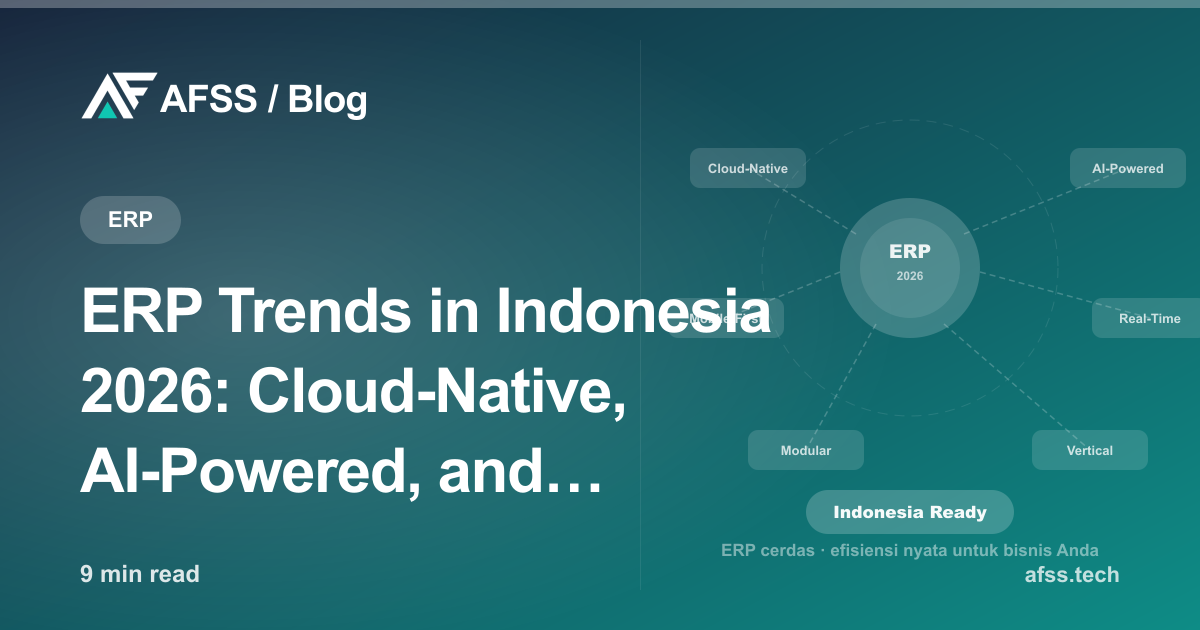
ERP (Enterprise Resource Planning) systems, once known as "rigid, expensive software that takes years to implement," are undergoing a major transformation. In 2026, the new generation of ERP is something entirely different: cloud-native, AI-powered, and designed for a mobile workforce.
This article covers the latest trends in the ERP world — with a focus on their relevance for Indonesian businesses currently in the middle of digital transformation.

Background: Why ERP Has to Evolve
Older-generation ERP was designed for a different world: staff worked in the office, data was stored on on-premise servers, and business processes were relatively stable and predictable. The world of 2026 looks different:
- Distributed teams: Some staff work remotely or semi-remotely
- Real-time expectations: Management wants real-time data, not monthly reports
- Speed of business change: Business models change faster, and ERP has to keep up
- Users accustomed to modern UX: Employees are already used to Tokopedia, Gojek, and modern apps — they don't want to learn a complex, old-fashioned system
An ERP that fails to evolve becomes a liability, not an asset.
Trend 1: Cloud-Native Architecture
The biggest shift in ERP is the move from on-premise (physical servers at the company's location) to cloud-native (running entirely on cloud infrastructure).
What's the difference from "cloud-hosted"?
Many legacy ERP vendors offer a "cloud version" that's really just old software moved onto a cloud server — not truly cloud-native. Cloud-native means an architecture designed from the ground up for the cloud: microservices, containerized, auto-scaling.
Advantages for Indonesian Businesses
No need to invest in physical servers: Mid-sized companies no longer need to buy expensive servers or hire a dedicated IT team for maintenance. Infrastructure is managed by the vendor.
Automatic scalability: During peak periods (Lebaran, year-end), the system automatically scales up — no need for complex capacity planning.
Automatic updates: The latest version with new features and security patches is instantly available — no more expensive, risky upgrade cycles every few years.
Access from anywhere: As long as there's internet, the ERP is accessible. Important for businesses with multiple locations or mobile teams.
Challenges in the Indonesian Context
- Internet connectivity: Areas with unstable connections can still be a barrier for cloud ERP
- Data regulation: Some industries (banking, healthcare) are tightly regulated on where data can be stored — a hybrid solution or data residency in Indonesia may be needed
Trend 2: AI-Powered Intelligence
Integrating artificial intelligence into ERP is no longer a premium feature — it's already a standard expectation in 2026.
AI Use Cases in Modern ERP
More Accurate Demand Forecasting AI-powered ERP analyzes sales history, market trends, weather, holidays, and even social media trends to predict demand far more accurately than conventional statistical models.
For FMCG distributors or Indonesian retailers, this means reduced stockouts and overstock — both of which hurt the business.
Automatic Anomaly Detection AI monitors thousands of transactions and automatically flags suspicious ones — potential fraud, entry errors, or deviations from normal patterns. Finance teams no longer need to manually review every line.
Smart Recommendations The system analyzes purchasing behavior and recommends the best suppliers, optimal purchase timing, or products that need reordering — without manual configuration.
Natural Language Queries Users can ask the ERP questions in plain language: "What were total sales last month compared to last year?" — and get an instant answer, without needing to know how to build a report in the system.
Predictive Cash Flow Analytics AI predicts cash flow 30/60/90 days ahead based on receivables, payables, and the current sales pipeline — helping management make better financing decisions.
Trend 3: Mobile-First Experience
Traditional ERP was designed for large desktop screens. 2026 ERP is built for mobile screens first.
Why Mobile Matters So Much for Indonesian Businesses
- Field staff: Salespeople, delivery drivers, field technicians — they work with phones, not laptops
- Multiple locations: Branch managers in other cities need real-time data access from their phones
- Mobile approvals: Decision-makers want to approve invoices or POs from their phone, without going to the office
- Culture: Smartphone penetration in Indonesia is very high, and teams are more familiar with mobile apps
Must-Have Mobile ERP Features
- Real-time dashboards that display well on small screens
- Approval workflow: Receive a notification, review details, approve/reject directly from a phone
- Barcode/QR scanning: Inventory checks and goods receiving directly with a phone camera
- Offline mode: Data stored locally when there's no connection, automatically syncing once back online
- Photos and attachments: Upload proof of delivery, damage photos, or documents from a phone camera
Trend 4: Modular and Composable Architecture
Large, rigid monolithic ERP is being replaced by modular architecture, where businesses can pick the modules they need and skip the ones that aren't relevant.
What This Means for Business
Phased implementation: Start with the most urgent module (e.g., inventory), add other modules as needs grow. No need to buy one big package upfront.
Integration with existing systems: ERP modules can be integrated with existing systems — no need to replace everything at once.
Best-of-breed approach: Use the best module from different vendors and integrate them via API. For example: inventory from one vendor, payroll from another, but everything connected to a unified dashboard.
Trend 5: Industry-Specific ERP
Generic ERP that tries to serve every industry is increasingly being abandoned. The market is moving toward vertical ERP — solutions designed specifically for a particular industry.
Examples in the Indonesian Context
ERP for FMCG distribution: Integrates distributor management, salesman tracking, goods returns, and dealer payments — matching the distribution model common in Indonesia.
ERP for construction: Project management, material tracking, actual costs vs. budget, progress billing — tailored to Indonesian contractor workflows.
ERP for plantations/agribusiness: Crop tracking, harvest seasons, processing steps, certifications — very specific and not something a generic ERP can handle.
ERP for garment manufacturing: Complex bills of materials, order-per-lot tracking, export certification, per-item costing.
Industry-specific ERP can be used right away rather than configured from scratch — faster and more accurate implementation.
Trend 6: Real-Time Analytics and Business Intelligence
2026 ERP isn't just an operational system anymore — it's also an analytics platform that supports decision-making.
The Shift from Old ERP
Before: Monthly reports, prepared by the finance team, often delayed by weeks
Now: Real-time dashboards the CEO can check from their phone any time, with data updating every minute
Capabilities now common in modern ERP:
- KPI dashboards customized per role (CEO, CFO, Warehouse Manager, Sales)
- Drill-down: from total figures → regional detail → sales detail → transaction detail
- Period comparison: this month vs. last month, this year's Q1 vs. last year's Q1
- Automatic alerts: "Stock for Product A is below safety stock" or "Customer B's receivable is 60 days overdue"
Trend 7: Faster, Cheaper Implementation
One of the biggest barriers to ERP adoption in Indonesia has been the perceived time and cost of implementation. The 2026 trend is changing this.
Factors Speeding Up Implementation
Pre-built industry templates: No need to configure from scratch — start with an industry template that can be customized right away.
Low-code customization: Configuration changes can be made without programming — by internal teams with minimal training.
Cloud deployment: No server installation, network configuration, or infrastructure setup needed — setup can be completed in a matter of days.
Data migration tools: Better tools for migrating data from legacy systems (Excel, simple accounting software) to the new ERP.
Phased implementation: Go live with core modules in 4-8 weeks, add other modules gradually — instead of waiting 12 months to go live.
ERP Adoption in Indonesia: Remaining Challenges
Despite these positive trends, ERP adoption in Indonesia still faces some obstacles:
Change management: Changing work habits that have been in place for years is a bigger cultural challenge than a technical one.
Data quality: Many Indonesian businesses still operate with data scattered across Excel, physical notebooks, or WhatsApp. Migrating and standardizing this data is a major undertaking.
IT talent limitations: Internal IT teams capable of managing an ERP aren't always available, especially at mid-sized businesses outside major cities.
Budget: Even though ERP costs have come down, there's still a perception that this is too big an investment. In reality, the cost of not implementing — in the form of lost efficiency — is often far greater.
Custom ERP vs. Packaged ERP: Still Relevant in 2026?
Amid all these trends, the classic question still stands: custom ERP or packaged ERP?
Choose a modern packaged ERP if:
- Your business processes are relatively standard
- You need fast implementation
- Budget is limited for upfront development
Choose custom ERP if:
- Your business flow is highly unique and can't be accommodated by a standard platform
- You already have existing systems that need deep integration
- You want full ownership of the code with no ongoing licensing costs
- You need the flexibility to develop very specific features
Conclusion
ERP in 2026 is no longer just about managing business data — it's a business intelligence system that helps you operate more efficiently, make faster decisions, and adapt to change more nimbly.
Indonesian businesses that haven't adopted modern ERP are ceding a significant competitive advantage to competitors who've already made the move.
AFSS builds custom ERP that fits the way Indonesian businesses actually work — instead of forcing a global template onto you. Get a free consultation to discuss the right ERP for your business, whether that's a packaged solution we integrate for you or custom ERP built from scratch.
Have a similar project?
Free consultation, no commitment. Tell us what you need — we'll help you find the best solution.
Free Consultation