ERP for Indonesian Manufacturing Companies: Benefits, Features, and Implementation
A garment factory in Central Java loses Rp 200 million a year due to miscalculated raw material needs — excess stock in one warehouse, shortages in another. A food producer in Surabaya fails to fulfill export orders because there's no real-time visibility into production capacity. Scenarios like these happen every day at Indonesian manufacturing companies that haven't implemented the right ERP system.
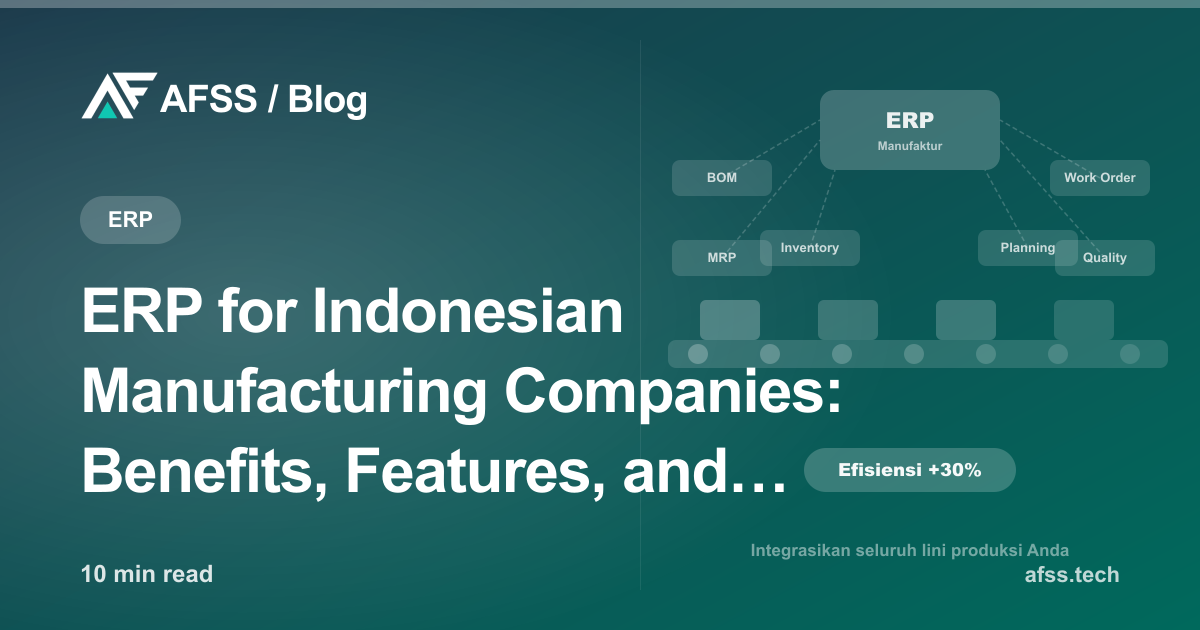
ERP (Enterprise Resource Planning) for manufacturing is not just an extended accounting software. It's an integrated system connecting the entire manufacturing business flow — from incoming customer orders, production planning, raw material procurement, shop floor production, quality control, all the way to shipping and invoicing — in a single unified platform.

Why Generic ERP Isn't Enough for Manufacturing
Many manufacturing companies try using generic ERP (designed for trading or service businesses) and end up frustrated. The reason is simple: manufacturing processes have unique complexities that don't exist in other businesses.
Specific manufacturing complexities an ERP must handle:
- Bill of Materials (BOM): A single finished product may consist of hundreds of components across multiple sub-assembly levels. ERP must be able to manage this multi-level BOM accurately.
- Work Order Management: Every production process needs to be planned, scheduled, and tracked — which machine is used, how many hours, which operator.
- MRP (Material Requirements Planning): Automatic calculation of material needs based on the production schedule and existing stock, to avoid shortages or excess inventory.
- Machine Capacity Planning: Optimizing machine usage so no bottleneck slows down production.
- Quality Control: Inspection at various production points, defective product handling, and traceability from raw material to finished product.
- Lot/Batch Tracking: The ability to trace which raw material lot a product was made from — crucial for recalls and compliance.
Generic ERP usually only has inventory and accounting modules. All the needs above must be handled manually or in separate systems — meaning data isn't integrated and decisions are always delayed.
Key Modules of Manufacturing ERP
1. Production Planning Module
This is the heart of manufacturing ERP. This module manages:
- Master Production Schedule (MPS): A short-term production plan (1–3 months) that serves as a reference for all departments
- Capacity Requirements Planning (CRP): Calculating whether machine and labor capacity is sufficient to meet the MPS
- Shop Floor Control: Real-time monitoring of production on the factory floor
2. Bill of Materials (BOM) Management
BOM is the "recipe" for each product — what components are needed, in what quantities, and the assembly sequence. A good manufacturing ERP supports:
- Multi-level BOM (product → sub-assembly → component)
- BOM versioning (for frequently updated products)
- Audited Engineering Change Orders (ECO)
3. Material Requirements Planning (MRP)
MRP is one of the most cost-saving features. Based on the production schedule and existing stock, MRP automatically calculates:
- What material needs to be ordered
- How much
- When it needs to be ordered (accounting for supplier lead time)
The result: no more expensive rush orders, no more stock piling up from over-purchasing.
4. Work Order & Routing Management
Every work order records:
- What operations need to be performed (routing)
- Which machine or work center is used
- Setup time and standard production time
- The responsible operator
- Actual material consumption vs. standard
This enables accurate production efficiency analysis and bottleneck identification.
5. Quality Management
A QC module integrated with production:
- Incoming Quality Control (IQC): Inspecting incoming raw materials before they enter stock
- In-Process Quality Control (IPQC): Inspection at critical points during production
- Final Inspection: Inspecting finished products before shipment
- Non-Conformance Report (NCR): Structured handling of defective products
6. Manufacturing-Specific Inventory Management
Unlike a retail store, factory stock has complex categories:
- Raw materials
- Work-In-Process (WIP) at various production stages
- Finished goods
- Machine spare parts
Manufacturing ERP must be able to manage stock movement between these categories automatically as production proceeds.

Real Benefits of ERP for Factories in Indonesia
Data from various manufacturing ERP implementations in Indonesia and Southeast Asia shows consistent results:
Operational Efficiency
- 15–25% reduction in material waste thanks to accurate MRP
- 10–20% improvement in OEE (Overall Equipment Effectiveness) from better scheduling
- 60–80% reduction in reporting time because real-time data is available on dashboards
Financial
- 20–30% reduction in inventory carrying cost due to more accurate stock
- 40–60% reduction in rush order premiums thanks to better procurement planning
- 15–30% improvement in on-time delivery to customers
Compliance & Traceability
- Complete traceability from raw material to finished product — important for halal certification, BPOM, or exports
- An audit trail for every transaction — easing the financial audit process
- Accurate, fast recall capability if a quality issue arises
A Guide to Choosing Manufacturing ERP for Businesses in Indonesia
Key Questions Before Choosing
What exact industry? ERP for garments differs from ERP for food & beverage, which differs again from ERP for electronics manufacturing. Choose an ERP with experience in your industry.
Business scale and IT team? A company with 50 employees and one with 500 have very different needs. Enterprise-scale ERP isn't suited for a mid-scale factory.
What integrations are needed? CNC machines that need integration, barcode/RFID systems, e-commerce, or existing accounting? Make sure the chosen ERP has this integration capability.
Cloud or on-premise? For manufacturing with sensitive data needs or unstable internet connectivity at the factory site, on-premise may be more suitable. Read the full comparison at Cloud vs on-premise ERP.
Total cost of ownership (5 years)? Including licensing, implementation, training, customization, and annual maintenance costs.
Red Flags When Evaluating Vendors
- The vendor can't show implementation references in the same industry
- No native MRP or production planning module
- Implementation timeline estimate is too short (under 4 months for a mid-sized factory)
- No structured training plan
- The contract doesn't specify who owns the data
A Realistic Implementation Timeline
Manufacturing ERP implementation takes longer than trading/service ERP:
| Phase | Typical Duration |
|---|---|
| Preparation & process mapping | 4–6 weeks |
| System configuration & data migration | 8–12 weeks |
| Parallel run (old and new systems running together) | 4–8 weeks |
| Go-live & stabilization | 4–8 weeks |
| Total | 5–8 months |
More complex factories (multi-plant, multi-product) may need 12–18 months for full implementation.
Where to Start?
You don't have to implement all modules at once. A phased approach recommended for mid-sized factories in Indonesia:
Phase 1 (priority): Inventory management + Purchase orders + Basic accounting Phase 2: BOM management + Work orders + Simple MRP Phase 3: Quality control + Advanced reporting + Barcode/machine integration Phase 4: Advanced planning + Analytics + Ecosystem integration
With a phased approach, teams adapt more easily and ROI is felt faster.
AFSS has experience building and implementing custom ERP systems for Indonesian manufacturing companies — from garment factories, food & beverage, to plastics manufacturing. There's no one-size-fits-all. Get a free consultation on manufacturing ERP for your business.
Have a similar project?
Free consultation, no commitment. Tell us what you need — we'll help you find the best solution.
Free Consultation