When people hear the term ERP (Enterprise Resource Planning), they often picture a massive system for factories with hundreds of product SKUs or complex distribution networks. Yet service businesses often have needs that are just as complex — sometimes with even more variables that are hard to manage manually.
A consulting firm managing dozens of parallel projects, a clinic with hundreds of patients and a dozen doctors, a creative agency that needs to track hours per client, or a construction company managing materials and subcontractors across several project sites at once — all of these face operational challenges that spreadsheets and WhatsApp groups simply can't solve.
This article covers how ERP can transform how service businesses operate, which modules are most relevant, and how to determine the right time to start implementation.
The Distinctive Challenges of Service Businesses
Service businesses have unique characteristics that make them complex to manage:
The "product" can't be stored. A service is produced and consumed at the same time. There's no finished-goods inventory that can be pre-ordered to cover a sudden spike in demand. Any excess or shortfall in capacity directly impacts revenue.
The main resource is people. Productivity, expertise, and team availability are the most critical assets. Managing schedules, project allocation, and team utilization without a proper system often becomes a bottleneck.
Revenue is measured per hour, per project, or per milestone. This differs from product businesses, where revenue is measured per unit sold. Tracking hours worked, project progress, and client billing requires a specific kind of system.
High contract complexity. Every client can have a different scope, price, and payment terms. Managing this variation manually is highly prone to error.
Trust and client retention are everything. Unlike a retail store that can keep gaining new customers from foot traffic, a service business is heavily dependent on repeat business and referrals. One dissatisfied client can have a much larger impact.
What ERP Solves for Service Businesses
Real-Time Visibility Across All Operations
Without ERP, a service business's operational data is scattered across various places: schedules in Google Calendar, project trackers in Asana/Trello, invoices in Excel, financial reports in MYOB, and client communication on WhatsApp. There's no single place that gives a complete picture.
ERP unifies all this data into a single source of truth. Management can see the status of all active projects, team utilization, revenue pipeline, and financial status in real time — without having to gather data from multiple, often out-of-sync spreadsheets.
Project Management Integrated With Finance
One of the biggest weaknesses of standalone project management tools (like Asana, Monday, or Jira) is that they're not connected to finance. You know project X is progressing, but you don't automatically know how much cost has been incurred, how much has been billed, and how much margin remains.
ERP for service businesses connects project management directly to time, cost, and billing records. Every hour logged, every purchase made, and every milestone reached is automatically linked to the project's financial reports. Managers can immediately see whether a project is on-budget or starting to run over.
Billing Automation
One of the biggest sources of "revenue leakage" in a service business is billing that's forgotten, delayed, or undercharged. Teams busy managing projects often forget to log extra hours worked or out-of-pocket costs that should have been billed to the client.
ERP automates this process: logged hours automatically generate a draft invoice based on the agreed rate, milestones reached can automatically trigger an invoice send, and the system automatically reminds clients when payment is late.
Better Resource Management
For team-based service businesses, allocating the right resources to the right projects at the right time is key to profitability. ERP provides resource planning that helps managers see overall team capacity, identify who's overloaded and who still has capacity, and plan hiring or subcontracting well before a capacity crisis hits.
ERP Modules Most Relevant to Service Businesses
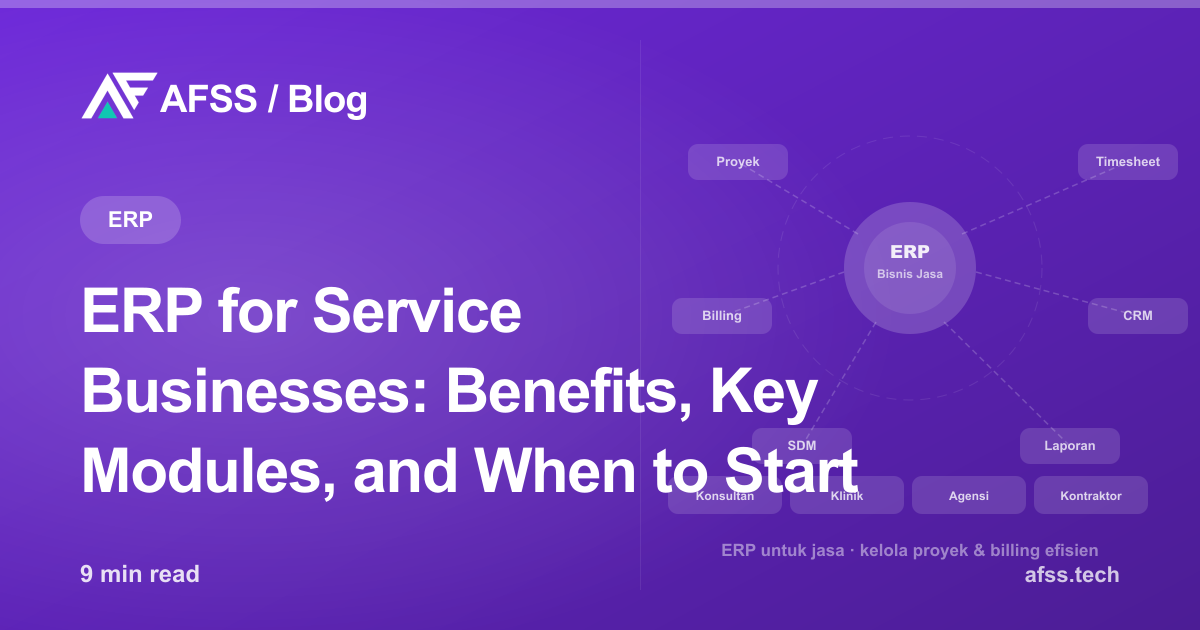
Unlike manufacturing ERP, which focuses on BOM (Bill of Materials) and production planning, ERP for service businesses prioritizes different modules:
CRM (Customer Relationship Management)
Manage the entire client lifecycle — from initial prospect, proposal, negotiation, contract, through project delivery and renewal. The entire history of client communication is stored in one place and accessible to anyone on the relevant team.
Project Management
Create and manage projects with clear milestones, team allocation, project budget, and progress tracking. Integrated with time tracking so every hour spent on a project is accurately recorded.
Time Tracking & Timesheets
Employees log hours worked per project (or per client, per task) directly in the system. This data becomes the basis for billing, team utilization evaluation, and per-project profitability analysis.
Billing & Invoicing
Create and send invoices based on actual data (hours worked, milestones, or reimbursable costs) with automation and professional formatting. Track payment status and send automatic reminders.
Finance & Accounting
Recording of revenue, operating costs, payroll, and financial reports directly connected to other modules. Profit-and-loss reports per project, per client, or per division can be generated at any time without a manual consolidation process.
HR & Payroll
Management of employee data, payroll calculation, leave, and performance evaluation. Integration with time tracking makes calculating productivity-based incentives easier.
Document Management
Contracts, proposals, reports, and project documents stored centrally with clear versioning and access control. No more confusion over "which document is the latest version."
Service Industries That Benefit the Most
Consultants and Professional Firms
Consulting firms (management, IT, legal, financial, HR) manage many parallel engagements with different clients, the same team rotating across several clients, and detailed reporting needs for every client. ERP provides the visibility needed to ensure no hours go unbilled and no project runs below minimum margin.
Creative and Digital Agencies
Advertising, digital marketing, design, and software development agencies face challenges similar to consultants, plus the need to manage creative assets, work revisions, and client approvals that often go back and forth. An ERP integrated with project management eliminates the need to reconcile data from multiple separate tools at the end of the month.
Clinics and Healthcare Services
Clinics need to manage doctor and patient schedules, medical records, medicine and equipment inventory, and billing connected to insurance and BPJS (Indonesia's national health insurance). ERP for clinics integrates all of this into a single system that minimizes manual administration and reduces the risk of errors.
Construction Companies and Contractors
Construction businesses manage many parallel projects with different subcontractors, materials, equipment, and labor. ERP provides full control over project costs, work progress, and subcontractor payment reconciliation — reducing the risk of a project finishing at a margin far below the initial estimate.
Education and Training Businesses
Course institutions, training centers, or tutoring services need to manage classes, instructor schedules, student enrollment, billing, and learning outcome evaluation. ERP simplifies administrative operations so focus can return to teaching quality.
When Should a Service Business Start ERP Implementation
Signs that your service business is ready and needs ERP:
- A team of more than 10 people where coordination now needs more than just a WhatsApp group
- More than 5 active parallel projects where it's hard to track the status and profitability of each
- Billing is frequently late or fees go uncharged due to a lack of a proper system
- Financial reports take several days to prepare because of manual consolidation
- There's inconsistency between what the team actually did and what's billed to the client
- Scalability is constrained — you want to add clients or projects but aren't sure the operational system can handle it
If you're experiencing 3 or more of these signs, now is the right time to seriously consider ERP.
Custom ERP vs. Off-the-Shelf ERP Software
There are two main options: using off-the-shelf ERP software (like SAP, Oracle, Odoo, or Zoho) or building a custom ERP designed specifically for your business processes.
Off-the-shelf ERP is quicker to implement and usually already has a complete feature set. However, it often requires adapting your business processes to fit how the system works — not the other way around.
Custom ERP is built to match your business's specific workflow, so there are no unnecessary features and no processes forced to follow a generic software's way of working. The initial investment is larger, but the result is a much better fit for your needs and easier for the team to adopt.
Also see our in-depth comparison: SaaS vs. Custom Software to help you consider the option that best suits you.
Conclusion
ERP isn't just for product businesses or large companies. A growing service business will reach a point where manual coordination is no longer sufficient, and higher operational efficiency becomes the key to maintaining profitability while continuing to grow.
AFSS has experience building custom ERP systems for various types of service businesses — from agencies to clinics, from consulting firms to contractors. We understand that every service business has its own uniqueness, and there's no one-size-fits-all solution. Get a free consultation to discuss your service business's ERP needs.
Have a similar project?
Free consultation, no commitment. Tell us what you need — we'll help you find the best solution.
Free Consultation