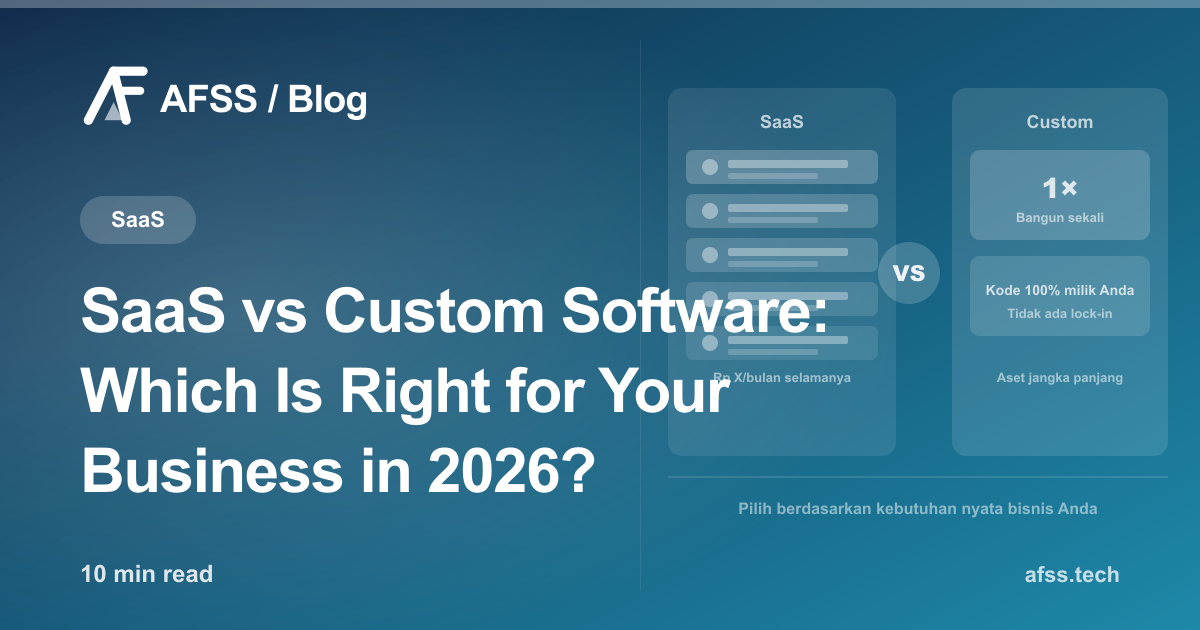
When a business needs a software solution — whether for CRM, project management, payroll, or other operational systems — there's always a fundamental choice to make: use an existing SaaS product, or build custom software?
There's no single answer that's always right for every situation. Both have their place, and the wrong decision can have a significant impact: wasted budget, operational constraints, or a dependency that's hard to escape.
This article helps you make this decision objectively, based on your business's actual needs and situation.
What Is SaaS?
SaaS (Software as a Service) is a model where software is accessed over the internet on a subscription basis, with no installation or maintenance required on the user's end. The software is hosted, updated, and maintained entirely by the vendor.
Familiar SaaS examples:
- Productivity: Google Workspace, Microsoft 365
- CRM: Salesforce, HubSpot, Zoho CRM
- Accounting: QuickBooks, Xero, Jurnal.id
- HR & Payroll: Talenta, Sleekr, Gadjian
- Project Management: Asana, Trello, Monday.com
- E-commerce: Shopify, WooCommerce (platform version)
- Marketing Automation: Mailchimp, ActiveCampaign
What Is Custom Software?
Custom software is software built from scratch (or heavily customized from an existing framework) specifically for the needs of one business or organization. All specifications, features, and workflows are designed to match that owner's unique business processes.
Examples of custom software:
- An internal management system specific to your industry
- Custom ERP tailored to your business's accounting and inventory processes
- A mobile app for field teams with highly industry-specific features
- An e-commerce platform with highly custom pricing, discount, and fulfillment logic
- An analytics dashboard displaying your business's specific KPIs
In-Depth Comparison: 8 Key Dimensions
1. Speed of Implementation
SaaS wins on this dimension.
Signing up for a SaaS account and getting started can take anywhere from hours to a few days. Basic configuration and team onboarding can be done within 1–2 weeks.
Custom software takes longer: from a few weeks for simple solutions to several months for complex systems. This includes discovery, design, development, testing, and deployment.
If a business needs a solution now and time is critical, SaaS is the right choice.
2. Cost — Short Term vs Long Term
This is the dimension most often misunderstood.
SaaS costs:
- No large upfront cost
- Monthly/annual subscription fee per user
- Feels cheap at first, but the cost runs forever
- Prices often rise as user count grows or when the vendor raises rates
- No accumulating "asset" value — stop paying, lose access
Example: SaaS CRM for 20 users at $30/user/month = $600/month = $72,000 over 10 years — and this price will likely go up.
Custom software costs:
- A larger upfront investment
- Once built, there's no subscription fee (only maintenance)
- The software is a fully owned business asset
- ROI improves over time — the longer you use it, the cheaper it is per year
Example: A custom CRM costing Rp 80M with Rp 10M/year in maintenance = after 5 years, a total cost of Rp 130M. Compare this to SaaS, which could cost twice as much over the same period.
Conclusion: For short-term use (under 2 years) or unclear needs, SaaS is more economical. For a long-term investment with clear requirements, custom software is often more cost-effective.
3. Customization and Fit With Business Processes
Custom software wins decisively on this dimension.
SaaS is designed to serve many businesses with different processes. As a result, there's often a compromise: you have to adapt your business process to how the software works, not the other way around.
For example, if your company's purchase approval process involves 4 levels of approval with very specific rules — chances are no SaaS can handle this exactly the way you want.
Custom software is built to match exactly how you do business. Every module, every workflow, every report reflects the way your team actually works — not a way dictated by a vendor.
This is crucial for businesses with unique or highly industry-specific processes.
4. Data Ownership and Privacy
Custom software wins on this dimension.
With SaaS, your business data is stored on the vendor's servers. This creates several risks:
- If the vendor goes bankrupt, merges, or is acquired, the fate of your data isn't guaranteed
- The vendor may use your data (aggregated/anonymized) for their own purposes
- For heavily regulated industries (healthcare, finance, legal), data compliance regulations can be hard to satisfy with public SaaS
- When you cancel your subscription, exporting your data can be complicated or result in data loss
With custom software, data is stored on infrastructure you control. You know exactly where the data lives, who can access it, and have the ability to protect it according to applicable regulatory standards.
5. Integration With Other Systems
A tie, depending on complexity.
Modern SaaS usually has an integration marketplace with hundreds of tools via platforms like Zapier or Make. For standard integrations (CRM to email marketing, e-commerce to accounting), this is more than adequate.
But for more complex integrations — especially with existing legacy systems, or highly specific data flows — SaaS often requires imperfect workarounds.
Custom software can be integrated with anything that has an API, including existing internal systems. There are no limitations imposed by a vendor.
Read more about system integration via API to understand how systems can be connected.
6. Scalability
SaaS is generally easier to scale technically.
SaaS is already designed to serve thousands of users — its infrastructure is already optimized for scale. Adding users or features just requires upgrading your plan.
Custom software can also be scalable, but requires proper architectural planning from the start and possibly additional investment as traffic or users grow significantly.
However, note that SaaS costs also scale linearly (more users = more cost). Custom software, once built, can add users without additional subscription cost.
7. Security and Compliance
Depends on context and configuration.
Enterprise SaaS vendors (Salesforce, AWS, Google) invest heavily in security. But SaaS security also depends on how you configure and use it.
For specific compliance needs (HIPAA for healthcare, PCI-DSS for payments, ISO 27001 for IT governance), some SaaS is already certified — but the options become very limited and expensive.
Custom software gives you full control over security and architecture, allowing you to implement very specific security measures tailored to your compliance needs.
8. Innovation and Evolution
SaaS excels for features commonly needed across an industry.
SaaS vendors continuously invest in developing new features relevant to their industry. You get new features automatically without additional development cost. This is very valuable if those features match your needs.
But for features very specific to your business, you're at the mercy of the vendor's roadmap. If a feature you need isn't on their roadmap, there's nothing you can do except wait or switch.
Custom software gives you full control of the roadmap — you decide what feature gets developed next, based on your own business priorities.
When to Choose SaaS?
SaaS is the right choice when:
- Your needs are standard and common — the process you need is already well served by existing SaaS
- You need a solution fast — there's no time for development
- The business is still in an experimental phase — it's not yet clear whether this process will stick
- Budget is limited upfront and you can allocate monthly operating costs
- You need features that are frequently updated to keep pace with regulations or industry trends
- Internal technical team is limited or non-existent
When to Choose Custom Software?
Custom software is the right investment when:
- Your business process is highly unique or industry-specific such that no SaaS fits
- You plan to use this software for the long term (5+ years)
- Integration needs with existing systems are very complex
- Data sensitivity is very high and you need full control
- SaaS costs are already very significant and keep rising with scale
- You want the software to be a competitive advantage — something competitors don't have
- Processes that can be automated could deliver massive operational efficiency
The Hybrid Approach That Often Works Best
Many businesses don't have to choose one or the other exclusively. A hybrid approach often delivers the best results:
- Use SaaS for common, standard functions (email, communication, basic HR)
- Build custom for core business processes that are unique and provide competitive advantage
- Integrate both through APIs so data flows seamlessly
For example: use Google Workspace for email, but build a custom order management system integrated with your existing accounting system — because your order management process is too complex for standard SaaS.
Signs You've "Outgrown" Your Current SaaS
These are signals that it's time to consider a custom solution:
- Your team spends a lot of time on workarounds because SaaS doesn't support the workflow you need
- Subscription costs already exceed 2–3% of total operating cost
- There's sensitive data you're uncomfortable storing with a third party
- Integration between various SaaS tools is becoming increasingly complex and fragile
- Your team complains that SaaS is too rigid and can't be adapted
Conclusion
There's no single right answer for every situation. SaaS and custom software are different tools for different needs. Smart businesses evaluate the trade-offs objectively and choose based on their real situation, not trends or assumptions.
If your process is standard and you need to start fast — SaaS is the smart choice. If your process is unique, you're planning for the long term, and you want software to be an asset you truly own — custom software is the right investment.
AFSS helps businesses objectively evaluate their needs and choose the most suitable approach — whether that's maximizing the use of existing SaaS, or building a custom solution that becomes your business's competitive edge. Get a free consultation to discuss your business software strategy.
Have a similar project?
Free consultation, no commitment. Tell us what you need — we'll help you find the best solution.
Free Consultation