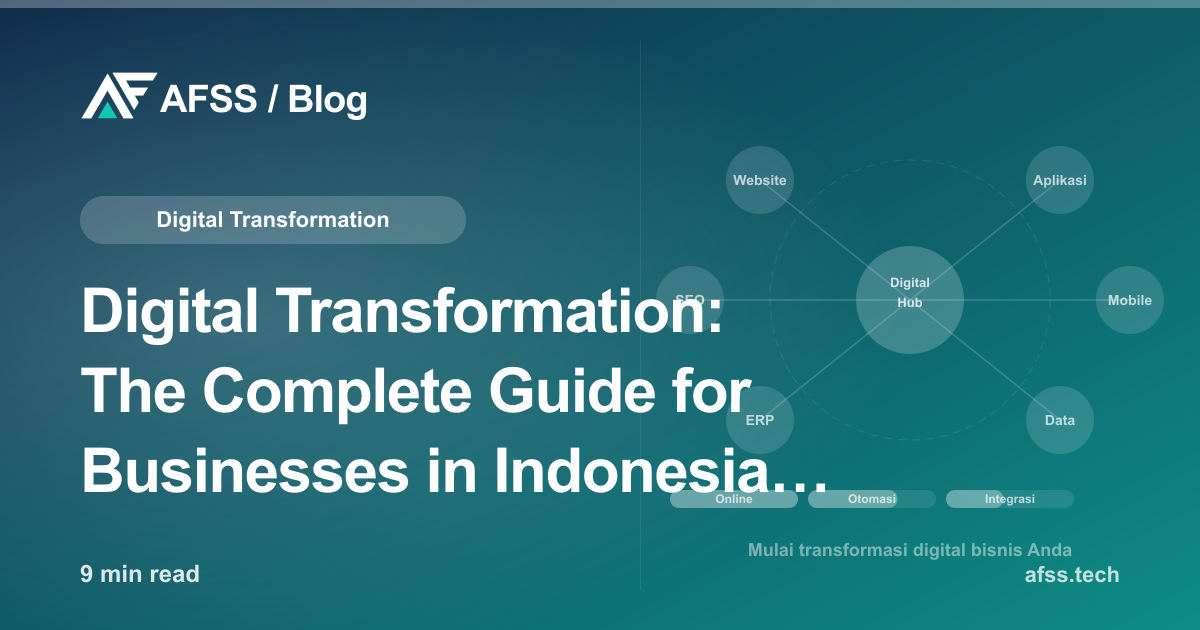
Digital Transformation: The Complete Guide for Businesses in Indonesia 2026
The term digital transformation sounds big and expensive. But at its core, it's simple: using technology to make a business run faster, more efficiently, and more scalable. In 2026, the question is no longer "whether" to transform — it's how and where to start.
What is digital transformation?
Digital transformation isn't just having a website or a social media account. It's a fundamental shift in how a business operates — replacing manual, fragmented processes with integrated digital systems.
Concrete examples:
- Sales tracked in Excel → replaced by an automatic CRM or ERP system.
- Word-of-mouth-only promotion → complemented by a website + SEO that brings in new customers 24/7.
- Financial reports compiled manually every month → replaced by a real-time dashboard accessible anytime.
- Customers reaching out via SMS → handled by a mobile app or web app with integrated notifications.
Digital transformation can happen gradually — it doesn't have to happen all at once.
Why does digital transformation matter in 2026?
1. Consumers are already digital
Research shows the majority of Indonesian consumers research products/services online before buying — whether through Google, social media, or marketplaces. Businesses without a digital presence lose out on these potential customers every single day.
2. Operational efficiency
Manual processes — data entry, monthly reports, stock reconciliation — eat up time and are error-prone. Digital systems cut this time drastically, freeing the team to focus on what truly matters.
3. Data as an asset
Digital businesses collect data: who their customers are, which products sell best, when traffic peaks. This data becomes the basis for much sharper decision-making than intuition alone.
4. Scalability
Digital systems can serve 10 customers or 10,000 customers with the same infrastructure. Growth no longer demands a linear increase in headcount.
5. Business resilience
The pandemic proved it: businesses with digital systems (online sales, remote teams, cloud-based reporting) are far more resilient to external disruptions.
Three pillars of digital transformation for business
Pillar 1 — Online Presence (Website & SEO)
The first step of digital transformation almost always starts here: an official website that can be found on Google.
A website isn't just a digital business card. A properly built website:
- Shows up on Google's first page when potential customers search for your services (SEO-friendly from the start).
- Is active 24 hours a day — answering questions, showcasing your portfolio, and encouraging prospects to reach out.
- Builds credibility that's hard to achieve through social media alone (read why SMEs must have a website).
For businesses that also sell products online, the next step is an online store — your own e-commerce platform that doesn't depend on marketplace fees.
Pillar 2 — Operational Automation (Web App & Mobile App)
Once you're online, the next step is automating internal processes. This is where web apps and mobile apps come in.
Web apps (browser-based applications) are a good fit for:
- Order and inventory management.
- CRM — customer database, transaction history, sales pipeline.
- Real-time reporting dashboards across departments.
- Dedicated client or partner portals.
Mobile apps make sense when your team or customers need intensive access from a phone — for example, an app for field sales teams, couriers, or customers who want to track orders. For timeline estimates, read how long it takes to build a mobile app.
We break down the differences between the three — website, web app, and mobile app — in more detail in this article.
Pillar 3 — Data Integration (ERP & Unified Systems)
For businesses that have already grown, the challenge shifts: it's no longer about "being online," but about data that isn't synchronized across departments.
This is where ERP (Enterprise Resource Planning) comes in. ERP unifies finance, inventory, sales, purchasing, and HR into a single system — so data is no longer "scattered across 5 different spreadsheets." Every decision is based on the same, up-to-date data. We cover ERP in detail in our dedicated ERP article.
Concrete steps to start your digital transformation
Digital transformation doesn't have to be a big-bang effort. Here's a realistic sequence:
Stage 1 — Online foundation (1–4 weeks)
- Build a professional, SEO-friendly website.
- Make sure there are clear services, portfolio, and contact pages, plus clear calls to action.
- Start blog content to target relevant Google keywords.
Stage 2 — Activate digital sales (4–8 weeks)
- Add an online store if you sell products.
- Integrate a payment gateway (Midtrans, Xendit, QRIS).
- Set up analytics to monitor performance.
Stage 3 — Operational automation (2–6 months)
- Build a web app for order, customer, or inventory management.
- Build a mobile app if your team or customers need access from a phone.
- Integrate automated notifications (email, WhatsApp).
Stage 4 — Full integration (6–12 months)
- Implement ERP to unify data across departments.
- Build an executive dashboard for real-time business monitoring.
- Automate financial reporting, payroll, and reconciliation.
Pitfalls to avoid
Don't choose a vendor that "locks you in"
Some vendors build systems with code you can never own — forcing you to keep paying them for maintenance forever. When choosing a software house, make sure the code fully belongs to you.
Don't transform everything at once
Too large a scope all at once increases the risk of a failed or delayed project. Start with the pillar that has the most impact for your business — usually a website plus one internal system.
Don't neglect team training
Even the best system is useless if the team doesn't know how to use it. Make sure there's proper onboarding and documentation.
Don't forget maintenance
Websites and digital systems need regular upkeep: security updates, backups, uptime monitoring. This isn't an extra cost — it's an investment to keep the system safe and running optimally. Read more about why website maintenance matters.
How much investment is needed?
There's no fixed number since it depends on scope. A rough picture:
- Professional website — starting from Rp 1M up to several million, depending on features. See our cost guide.
- Simple web app — starting from Rp 4M–8M.
- Mobile app — starting from Rp 8M–15M for an MVP.
- ERP — highly variable; priced per project based on modules and complexity.
What matters most: compare this against the cost of not transforming — wasted time, unreached customers, inaccurate data.
Conclusion
Digital transformation isn't a one-time project — it's a journey that starts with a single step. Start with a strong online presence, automate the process that eats up the most time, then integrate data as your business grows.
AFSS is here as your digital transformation partner — from websites, mobile apps, and web apps to custom ERP systems. All code belongs to you, every process is transparent, and every technology is modern. Get a free consultation via WhatsApp to start mapping out your business's digital roadmap.
Have a similar project?
Free consultation, no commitment. Tell us what you need — we'll help you find the best solution.
Free Consultation